
Last checked: October 16, 2026 · Sources: Seoul Metro fare page and passenger terms, Seoul Metropolitan Government, Tmoney and AREX, linked below.
The Seoul subway fare is 1,550 won for the first 10 km with a transit card such as T-money, and 100 won more for each extra 5 km. A single-journey ticket costs 100 won more per ride, plus a 500 won deposit that you get back from a machine after you exit. Only a card gives you the free transfer to a bus within 30 minutes, and foreign contactless credit cards still can’t be tapped at the gates.
Which card to buy (T-money, WOWPASS or the Climate Card pass) is covered in our T-money vs WOWPASS vs Climate Card comparison. This guide is about what you pay per ride and what to do when a gate stops you.
How much is a subway ride in Seoul?
The fare depends on distance, counted along the shortest route, not on how many lines you change between. Changing lines inside the gates costs nothing extra.
| Distance | Adult, card | Adult, single-journey ticket | Child (6–12), card or ticket |
|---|---|---|---|
| Up to 10 km | 1,550 | 1,650 | 550 |
| Up to 15 km | 1,650 | 1,750 | 600 |
| Up to 20 km | 1,750 | 1,850 | 650 |
| Up to 25 km | 1,850 | 1,950 | 700 |
| Up to 30 km | 1,950 | 2,050 | 750 |
| Up to 35 km | 2,050 | 2,150 | 800 |
| Up to 40 km | 2,150 | 2,250 | 850 |
| Up to 45 km | 2,250 | 2,350 | 900 |
| Up to 50 km | 2,350 | 2,450 | 950 |
Fares in won, from Seoul Metro’s fare table. Beyond 50 km, 100 won is added per 8 km.
A few rules that change the price:
- Before 06:30: with a card, the base fare is 20% off if you board from opening time until 06:30. It doesn’t apply when you transfer from another bus or train.
- Teens (13–18): the 900 won teen fare needs a teen card registered with a birth date. On a single-journey ticket, teens pay the adult fare.
- Under 6: free, up to three children per adult.
A route app shows the exact fare before you go; see our Google Maps in Korea guide for which apps give transit directions.
How does a single-journey ticket work?
It’s a reusable plastic card that you buy for one trip and hand back at the end.
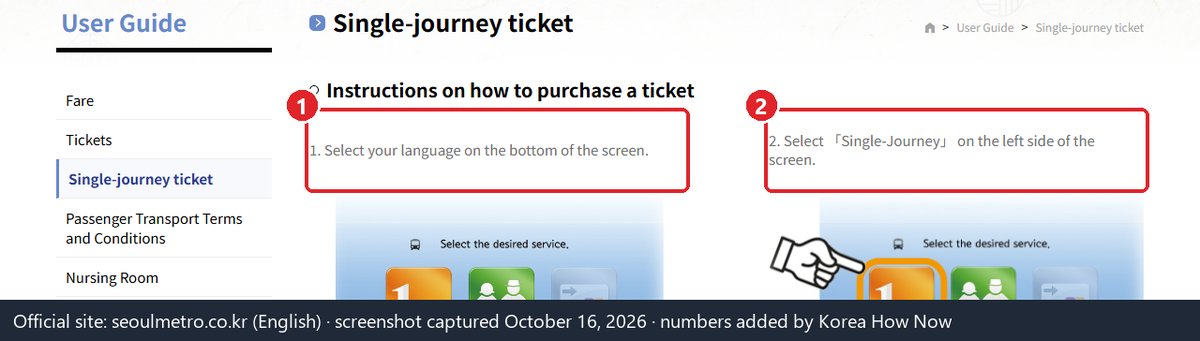
- At a ticket machine, choose English, then Single-Journey, and search for your destination station.
- Pay the fare plus a 500 won deposit. Seoul Metro asks that you use 500-won coins for the deposit if you can.
- Tap the ticket on the T-money reader on the right side of the gate.
- After you exit, put the ticket into the deposit refund machine and take your 500 won back.
Things the passenger terms say about these tickets:
- It doesn’t have to be used on the day you buy it, but it’s good for one ride only, and only on the subway (no bus transfer).
- Once you’re through the gate, you have 5 hours to exit, or you pay an extra base fare.
- You can still get the deposit back later, as long as the ticket isn’t damaged. If you didn’t use it at all, any station refunds the fare too.
Can I buy a single ticket with a foreign credit card?
Yes, at the newer machines. Since March 17, 2026, Seoul says 440 new ticket machines at 273 stations on Lines 1–8 accept overseas Visa and Mastercard cards (and Kakao Pay or Naver Pay) for single-journey tickets and Climate Card short-term passes. There’s an average 3.7% service fee on foreign cards. The announcement covers only these new machines on Lines 1–8, so elsewhere plan on paying cash.
Single ticket or T-money: which is cheaper?
Our math, using the official prices: a basic T-money card costs 3,000 won, which you don’t get back, and cashing out leftover balance costs a 500 won fee. Each subway ride is 100 won cheaper on the card than on a single ticket.
| What you do | Single tickets | T-money card (3,000 won card + 500 won refund fee) |
|---|---|---|
| 1 subway ride, under 10 km | 1,650 | 1,550 + 3,500 = 5,050 |
| 10 subway rides, under 10 km | 16,500 | 15,500 + 3,500 = 19,000 |
| Subway then bus, under 10 km in total | 1,650 + 1,500 (bus) = 3,150 | 1,550 (transfer included) |
On subway rides alone, the card only pays for itself after about 35 rides. What changes the answer is the bus: with a card, a bus within 30 minutes of leaving the subway is included in one 1,550 won fare for the first 10 km, while a single ticket gets no transfer at all. Two or three subway-to-bus trips cover the card’s cost.
Our view: if you’ll only ride the subway a handful of times and never take a bus, single tickets are fine and you skip the card fee. For anything longer than a weekend, or if your hotel is a bus ride from the station, get T-money on day one. You also avoid the deposit step at every exit.
How do transfers work between subway and bus?
Seoul uses one fare for a whole journey if you pay with a card:
- Time limit: board the next bus or train within 30 minutes of tapping off, or within 60 minutes between 21:00 and 07:00.
- Tap off the bus. If you don’t tap your card when you get off a bus, you lose the transfer and pay a new fare on the next ride.
- Up to 4 transfers (5 rides) count as one journey. Getting back on the same bus route doesn’t count as a transfer.
- Price: the base fare covers the first 10 km of the whole journey, then 100 won is added for each 5 km. If you use a bus with a higher base fare, that higher fare applies.
- One card per person. Several people can’t transfer from a bus to the subway on one card.
Single-journey tickets and cash on the bus get none of this.
Can I tap my foreign credit card at the gate?
No. Seoul Metro gates read Korean transit cards (T-money and similar), not overseas contactless Visa or Mastercard cards. Seoul’s plan, announced in October 2025, is to fit international card readers on Lines 1–8 in 2027 as part of a 2025–2030 changeover. We found no official notice that it has started. Not officially confirmed for your dates — check before you go.
What a foreign card can do today is buy single tickets and Climate Card passes at the new machines (see above). A plain T-money balance is still topped up with Korean won in cash, at station machines or convenience stores.
If the gate rejects your card
The gate beeps and won’t open when I enter.
Your card needs at least the base fare (1,550 won) on it to start a trip. Top it up with cash at a station top-up machine. Commonly reported: two transit cards in the same wallet or phone case can confuse the reader, so tap with only one card.
The exit gate says my balance is too low.
Use the fare adjustment / top-up machine inside the gates, add cash, then tap out again.
I went through the wrong side for my direction.
With a T-money-type card, exit and tap back in at the same station within 15 minutes with the same card, and Seoul Metro won’t charge a new base fare. At a transfer station this only works on the same line, it works once per trip and uses up one of your free transfers, and Seoul Metro lists where it applies: its own parts of Lines 1–8, Line 9, the Ui-Sinseol Line and the Sillim Line. It also covers a quick exit for a toilet. It does not apply to single-journey tickets.
I forgot to tap out.
An extra fare is added the next time you tap in. On a Climate Card pass, two missed exit taps in one pass period lock the card for 24 hours from your last boarding. More on the pass in our Climate Card short-term pass guide.
The gate didn’t read my card at all, or it’s broken.
Ask the staff at your exit station. Don’t walk through on someone else’s tap: riding without a valid tap-in costs the single-ticket fare plus 30 times that fare as a penalty.
I took the wrong train.
Tell a station staff member. If they confirm it, you can go back in the right direction on the same ticket.
My top-up failed or the machine won’t take my card.
Topping up a physical T-money card at station machines and convenience stores is cash only (Korean won). If you only have a foreign card, buy a single-journey ticket at a new machine for this ride and get cash from a Global ATM before the next one.
Help lines: Seoul Dasan Call Center 120, press 9 for foreign languages; Tmoney customer centre 1644-0088 (weekdays 09:00–18:00).
What’s different on the Airport Railroad (AREX)?
The AREX All-stop train works like the subway: tap T-money, or buy a single-journey ticket (+100 won, 500 won deposit back at your arrival station). One single ticket covers AREX plus the connecting subway. Inside Seoul, AREX uses the same distance fares, but the airport section has its own higher fare.
| AREX All-stop, adult card fare | Won |
|---|---|
| Incheon Airport T1 → Seoul Station | 4,750 |
| Incheon Airport T2 → Seoul Station | 5,350 |
| Incheon Airport T1 → Hongik Univ. | 4,650 |
| Gimpo Airport → Seoul Station | 1,750 |
The AREX Express is a separate ticket bought at the airport, not a card tap. Times, the Express fare and last trains are in our Incheon Airport arrival guide. A Climate Card pass can’t be used to board at Incheon Airport.
Read next
Sources
- Seoul Metro — Fare guide (distance fares, single-ticket fares, early-bird discount, subway–bus transfers), checked Oct 15, 2026 (Korean)
- Seoul Metro — Ticket guide (single-journey ticket and 500 won deposit), checked Oct 15, 2026 (Korean)
- Seoul Metro — Single-journey ticket machine steps, checked Oct 15, 2026
- Seoul Metro — FAQ (deposit refunds, re-entry within 15 minutes), checked Oct 15, 2026
- Seoul Metro — Passenger Transport Terms, Lines 1–8 (in force from Mar 7, 2026), checked Oct 15, 2026 (Korean)
- Seoul Metropolitan Government — Subway fares, checked Oct 15, 2026 (Korean)
- Seoul Metropolitan Government — Bus fares and transfer rules, checked Oct 15, 2026 (Korean)
- Seoul Metropolitan Government — Foreign cards at subway ticket machines from Mar 17, 2026 (Mar 16, 2026), checked Oct 15, 2026 (Korean)
- Seoul Metropolitan Government — Open-loop card payment plan for buses and subway (Oct 16, 2025), checked Oct 15, 2026 (Korean)
- Tmoney Co. — Foreigner Guide (top-up, transfer discount, refunds), checked Oct 15, 2026
- Tmoney Co. — Tmoney card list and prices, checked Oct 15, 2026 (Korean)
- AREX — All-stop train fares, checked Oct 15, 2026 (Korean)
- AREX — All-stop train tickets, checked Oct 15, 2026 (Korean)