
Last checked: October 7, 2026 · Sources: Seoul Metropolitan Government transport pages (news.seoul.go.kr/traffic) and T-money — linked below.
Tourists can still buy short-term Climate Card passes: 1 day 5,000 won, 2 days 8,000, 3 days 10,000, 5 days 15,000, 7 days 20,000. They give unlimited rides on Seoul subway and Seoul city buses, plus getting off at Incheon Airport T1/T2. Buy a physical card (3,000 won) from a Line 1–8 station machine or a convenience store near a station, then charge a pass on the day you start using it. Since March 17, 2026, Seoul says the Line 1–8 machines accept foreign-issued credit and debit cards. The 30-day pass ended in October 2026; its replacement, the Climate Pass (기후동행패스), is for Seoul residents.
What changed on Oct 1, 2026
- 30-day Climate Card (prepaid and postpaid): ended.
- Short-term passes (1/2/3/5/7 days): still on sale, same prices. The Seoul FAQ says they “are maintained as before.”
- But the area got smaller: stations in Gimpo, Goyang, Gwacheon, Guri, Seongnam, Hanam and Namyangju, which used to be covered, are no longer included. The pass now works inside Seoul only (plus getting off at Incheon Airport).
- Ttareungyi bikes and the Hangang Bus: not included in short-term passes.
Prices
| Pass | Price | Per day |
|---|---|---|
| 1 day | 5,000 won | 5,000 |
| 2 days | 8,000 won | 4,000 |
| 3 days | 10,000 won | ~3,333 |
| 5 days | 15,000 won | 3,000 |
| 7 days | 20,000 won | ~2,857 |
| 7 days, youth (13–18) | 13,000 won | from Sept 1, 2026, until the resident Climate Pass gets its own youth discount (no end date set); needs age verification on the T-money site |
| Physical card | 3,000 won (one-time, reusable) |
Seoul’s FAQ says short-term passes, which are aimed at foreign travellers and short-term visitors, get no other discounts (low-income, multi-child, young adult). The youth 7-day price is the one exception. Seoul says it will run until the resident Climate Pass gets its own youth discount and gives no end date. Eligibility goes by birth year (2008–2013 in 2026), and you must register the card and verify age on the T-money website first.
How the days are counted
- The day you charge is day 1. You can’t pre-charge for a later date. Charge a 3-day pass on Monday and it covers Monday, Tuesday and Wednesday.
- Each pass runs from the first train (04:00) on day 1 to the last train on the final day, which Seoul describes as “usually 04:00 the next day.”
- Night buses: Seoul’s FAQ says a card can still be tagged on a night bus between 00:00 and 04:00 after its last day.
So don’t charge a pass the evening you land unless you’ll use it that night. Charge it the next morning.
Where it works
From Seoul’s short-term pass page (service range “from Oct 1, 2026”):
| Included | Not included |
|---|---|
| Subway within the Seoul area | Sinbundang Line |
| Getting off at Incheon Airport T1 / T2 (AREX) | GTX |
| Seoul-licensed city buses (trunk, branch, circular, night) | Subway stations outside Seoul |
| Seoul-licensed village buses | Metropolitan (red) buses and airport buses |
| Buses licensed by other cities (Gyeonggi, Incheon) | |
| Ttareungyi bikes, Hangang Bus | |
| Taxis |
Two rules catch people out:
- Leaving Seoul by subway costs extra. If you board inside Seoul and get off outside it (Seoul’s example: Jongno 3-ga to Indeogwon in Gyeonggi), the card isn’t accepted at exit and you pay the full fare from your boarding station.
-
The airport works one way. You can ride to Incheon Airport T1 or T2 and get off there. You can’t board at those stations with the pass. Going from the airport into Seoul, you pay normally.
-
Gimpo Airport is covered, except one line. Seoul’s station search shows Gimpo Airport station as usable (boarding and exiting) on Line 5, Line 9, AREX and the Seohae Line, but not on the Gimpo Goldline. You can buy the card at the Line 5 station there and charge it at the Line 5 or Line 9 station.
Seoul buses are fine even when they cross into Gyeonggi, as long as the bus is Seoul-licensed. Seoul has a service-range search tool (in Korean) for checking a specific station or route.
Not sure the pass beats a plain T-money card or WOWPASS? See our T-money vs WOWPASS vs Climate Card comparison.
Where to buy and charge
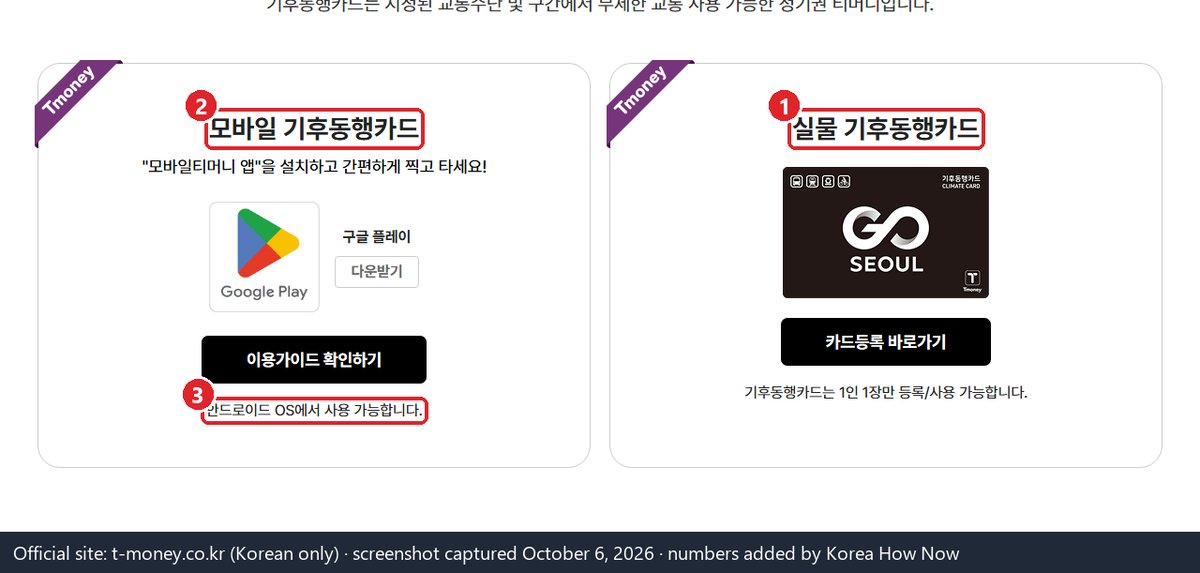
Physical card (works for most visitors)
- Buy the card (3,000 won) from the new-type ticket machines in Seoul Metro Line 1–8 stations, or from convenience stores near stations. T-money names GS25, CU, 7-Eleven, emart24 and Storyway. On Line 9, the Ui-Sinseol Line and the Sillim Line, buy it at nearby convenience stores.
- Charge your pass at the unmanned charging machines in Line 1–8, Line 9, Ui-Sinseol, Sillim and Gimpo Goldline stations, or by holding the physical card to your phone in the Mobile T-money app (T-money lists the menu for both Android and iPhone).
- Payment: cash, or a credit/debit card (not corporate cards). Seoul’s FAQ says foreign-issued cards have been accepted since March 17, 2026, both for buying the card at the Line 1–8 machines and for charging. T-money adds that foreign-issued cards may be declined or charged a separate overseas card fee. Carry some cash in case a machine rejects your card.
- Register the card (optional) via the QR code on the back, which opens the T-money website. Seoul’s FAQ says you can ride without registering, but only registered cards can check usage, report loss and request a refund.
Already have a Climate Card from the old 30-day pass? You don’t need a new one. Seoul’s FAQ says the pass type is chosen when you charge, so you can charge a short-term pass onto the card you already own.
Mobile card (mostly not for tourists)
The mobile version needs an Android phone (OS 12+) with the Mobile T-money or Samsung Wallet app, plus identity verification with a phone in your own name. Seoul’s FAQ says that without identity verification you can’t get a mobile card and should use a physical card instead. Apple Pay is not supported.
Rules to know
- One person, one card. You can’t pay for a friend with your card, and you can’t transfer it.
- Unlimited transfers, and no distance-based extra fares within the covered range.
- Lose the card, lose the pass. Seoul’s FAQ says the remaining days are not carried over to a new card, registered or not. A registered card can at least apply for a refund after reporting the loss.
- Tag-less gates don’t work with the Climate Card. Tag it.
Refunds
From Seoul’s page: refund = amount charged − fares you actually used − 500 won fee. T-money’s steps: stop the card before the pass expires (at a station charging machine or in the Mobile T-money app), then file the refund on the T-money website within 15 days of the expiry date. Miss the first step and there’s no refund.
For a tourist this is hard in practice, and Seoul’s own pages don’t fully agree:
- Seoul’s pass page says refunds go to a bank account or as a partial cancellation on the card you paid with, and that foreigners without a Korean bank account can get a cash refund by visiting T-money’s head office.
- Seoul’s FAQ says short-term passes can be refunded only if the card is registered on the T-money website. Joining T-money needs verification with a phone in your own name or an I-PIN, and the I-PIN route needs a Korean alien registration number. Visitors without a Korean phone in their own name or an alien registration number usually can’t do either. The same FAQ also says refunds can only be requested online, to a bank account, which doesn’t match the head-office cash refund above.
If you need a refund, call T-money (1644-0088) before the pass expires. Better still, buy the shortest pass that covers your plans and don’t count on getting money back.
What ended on Sept 29–30, 2026
| Product | What happened |
|---|---|
| Prepaid 30-day Climate Card | Charging ended Aug 31, 2026; last day of use Sept 29; unusable from Sept 30 |
| Postpaid Climate Card | Discount applied to September use; ended Sept 30. From Oct 1 it works as an ordinary transport card |
| Climate Card (30-day) as a whole | Operation ended Oct 1, 2026 |
| Short-term passes (1/2/3/5/7 days) | Continue (Seoul says they’ll keep running, valid in Seoul) |
Seoul’s replacement for residents is the Climate Pass (기후동행패스), built on the national “Everyone’s Card” (모두의카드, K-Pass). Seoul’s description targets residents aged 19+ with a Seoul address. Its FAQ says foreigners can join only if they have an alien registration number and can complete Korean identity verification. If you’re visiting for a week or two, ignore it.
People who bought a physical Climate Card for the 30-day pass can’t get the card’s purchase price back.
Short-term pass vs paying per ride with T-money
The adult subway base fare by transport card is 1,550 won for the first 10 km (Seoul city fare page). Rough break-even, using the per-day prices above:
| Pass | Worth it if you take, per day, about… |
|---|---|
| 1 day (5,000) | 4+ separate base-fare trips |
| 3 days (10,000) | 3+ trips a day |
| 7 days (20,000) | 2+ trips a day |
This is a simplified comparison. With an ordinary T-money card, transfers between subway and bus within the time limit are already free or cheap, so a “trip” here means a separate journey, not each vehicle. Longer subway rides cost more per trip on T-money, which favours the pass. Cheaper rides, such as Seoul village buses, work the other way: if most of your trips are on those, you need more rides a day to break even. Trips outside Seoul, on the Sinbundang Line, by airport bus or from the airport into Seoul need a normal transport card anyway, so many visitors carry both.
Private prepaid travel cards sold to tourists (such as WOWPASS) are separate products with their own terms, so check those with the seller.
Climate Card problems and fixes
I charged a 3-day pass at 9 p.m. on arrival.
That evening counted as day 1. Charge on the first morning you’ll ride.
The gate rejected my card at the airport.
The pass covers getting off at Incheon Airport T1/T2, not boarding there. Pay for that ride with another card.
I got charged at Pangyo / Suwon / Ilsan.
You got off outside Seoul’s covered range, or rode the Sinbundang Line. You pay the full fare for that ride.
Can my partner use my card?
No. One person per card, one tap per ride.
Can I add it to Apple Pay?
No. iPhone users need the physical card.
I lost my card on day 2.
The remaining days are gone, even for registered cards. Keep it separate from your other cards.
Does it include the Hangang Bus or Ttareungyi bikes?
Not on short-term passes.
Related guides
- Incheon Airport arrival, step by step: the pass can’t be used to board at the airport, so here is how to get into Seoul
- Naver Map in English (2026): subway and bus routes with live arrival times.
- Korea eSIM vs USIM vs pocket Wi-Fi: getting mobile data for maps and transit apps.
- Booking KTX/SRT with a foreign credit card: for trips beyond Seoul.
Help
- T-money customer centre (charging, refunds, errors): 1644-0088
- Seoul Dasan Call Center: 120 (from abroad +82-2-120)
- Korea travel hotline (English): 1330
Read next
Paying per ride instead? Fares by distance, transfer rules and gate fixes are in our Seoul subway fares, single tickets and transfers.
Sources
- Short-term pass overview (prices, validity, service range from Oct 1, 2026, exclusions, where to buy and charge, refund formula, cash refund at T-money head office for foreigners without a Korean account; modified Oct 1, 2026)
- Short-term pass FAQ (foreign cards for buying and charging since Mar 17, 2026; foreigners can buy; registration optional but needed for refunds; existing card can be charged with a short-term pass; service range narrowed from Oct 1, 2026; mobile needs own-name phone; Apple Pay not supported; lost card; no other discounts for short-term passes; Ttareungyi/Hangang Bus excluded; youth 7-day price kept until the Climate Pass adds a youth discount, Q59 and Q93)
- 30-day pass end FAQ (short-term passes maintained; Seoul-only; card price not refunded)
- “How long can I use the Climate Card?” (charge until Aug 31, use until Sept 29, end Oct 1)
- 30-day pass end notice (prepaid charging ended Aug 31; postpaid ended Sept 30)
- Youth discount 7-day pass
- Climate Pass launch and FAQ (residents; foreigners need alien registration number): news.seoul.go.kr · news.seoul.go.kr
- T-money Climate Card page (convenience-store brands, refund rule)
- Short-term pass service-range search (Gimpo Airport: Line 5, 9, AREX, Seohae Line yes; Gimpo Goldline no; searched Oct 7, 2026)
- Seoul subway fares (1,550 won base by card)