
Last checked: October 11, 2026 · Sources: Hana Bank, Standard Chartered Korea, KB Kookmin Bank, Visa, Mastercard and UnionPay pages, linked below.
New here? Start with our Incheon Airport arrival guide: immigration, customs, SIM or eSIM, money and the train or bus into Seoul, step by step.
You can get Korean won from an ATM in Korea with a foreign card on the Visa, Mastercard or UnionPay networks, but only some machines are set up for foreign cards. JCB and other cards may work too; check the logos on the machine. Use a machine marked Global ATM or showing your card network’s logo, pick English on the first screen, and choose to be charged in won (KRW), not your home currency. Before you fly, ask your own bank about its overseas ATM fee and your daily withdrawal limit, because we found no Korean bank that publishes what it charges foreign cards.
Which ATMs in Korea take foreign cards?
Look for two things on the machine or its screen: a “Global ATM” sign, and the logo of your card network. Hana Bank says cards with Mastercard, Maestro, Cirrus, Visa, PLUS, JCB or UnionPay logos can check balances at its Global ATMs (its FAQ covers balance inquiries, not withdrawals). UnionPay notes that its logo may appear only on the screen, or not at all, on machines that still accept it.
This is what each official source actually says about foreign cards. We read the banks’ own English and Korean pages; where a column is blank in practice, the bank simply doesn’t say.
| ATM or network | What the official page says about foreign cards | Fee for foreign cards | Limit per withdrawal |
|---|---|---|---|
| Hana Bank Global ATM | Cards with Mastercard, Maestro, Cirrus, Visa, PLUS, JCB or UnionPay logos can check balances; Philippine and Malaysian cards can’t | Not published; Hana says balance-inquiry fees may apply depending on the country and card company | Not published |
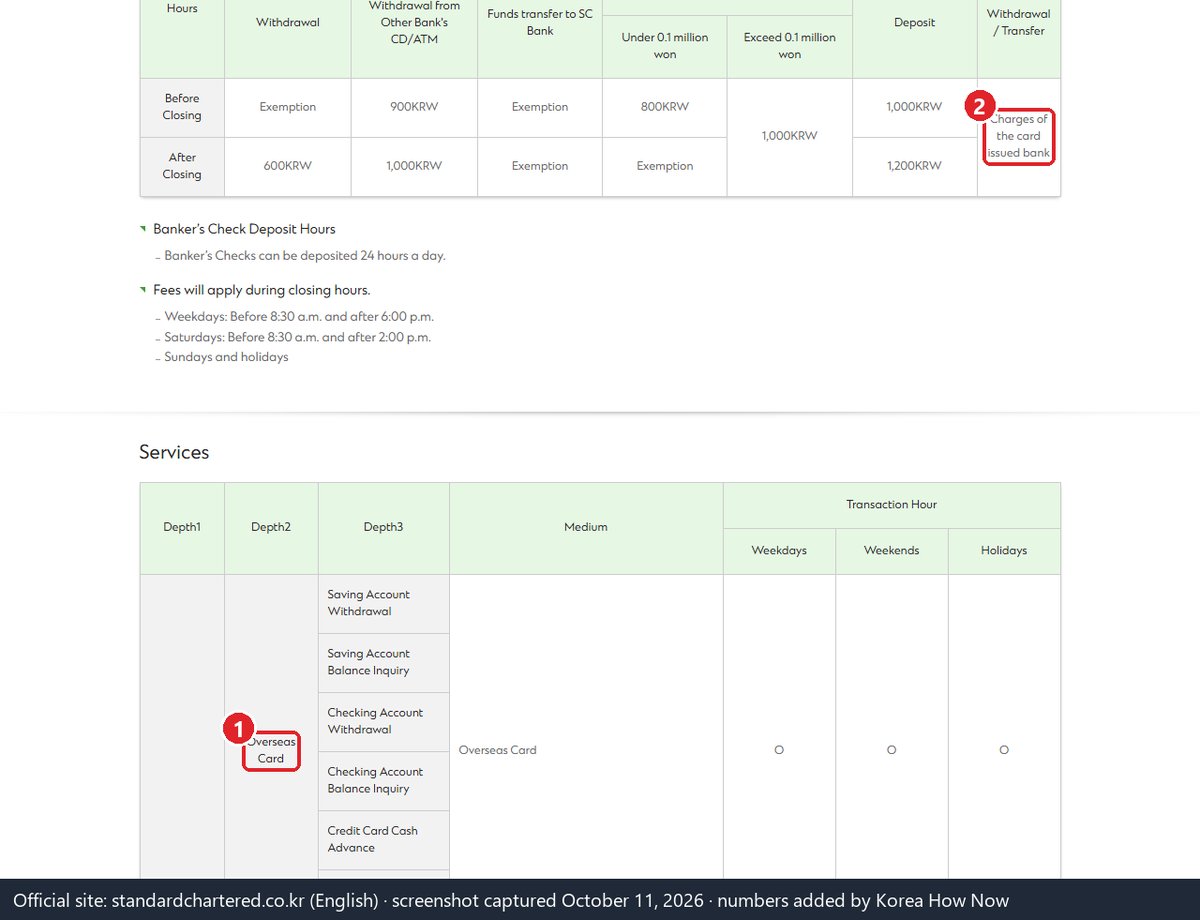
| Standard Chartered Korea (SC) | English menu has “Overseas Card”: withdraw from savings or checking, or credit card cash advance, on weekdays, weekends and holidays | Not listed for overseas cards; for other banks’ cards SC says “Charges of the card issued bank” | Other banks’ cards follow their own bank’s policy |
| KB Kookmin Bank | KB’s ATM guide (for overseas remittance) starts with an ENGLISH / 日本 / 中國語 choice; no foreign-card withdrawal guide | Non-KB customers pay their own bank’s charges | Not published |
| UnionPay network | Korea is on its ATM list, and accepting ATMs in Korea have a Chinese menu | Set by your issuer; some ATM owners add a surcharge shown on screen | The cap shown on that ATM; mainland China-issued cards also max out at the equivalent of RMB 10,000 per card per day and RMB 100,000 per year |
| Visa and Mastercard | Visa cards with the PLUS logo work at ATMs with the PLUS mark; Visa runs an online ATM locator, and Mastercard has one too | Set by your issuer | Your card’s daily limit |
Arriving at Incheon? The airport lists its ATMs but doesn’t say which take foreign cards. Our Incheon Airport arrival guide shows where they are and the exchange counters to use if your card is refused.
Our view: if a machine at a convenience store or subway station rejects your card, don’t keep retrying at the same brand. Walk to a bank-branded Global ATM instead. SC is the bank that lists overseas-card withdrawals on its ATM page, and Hana confirms foreign-card balance checks at its Global ATMs.
How do I withdraw cash step by step?
- Find a Global ATM or a machine showing your card’s network logo.
- Choose English on the first screen. KB’s ATM guide shows an “ENGLISH / 日本 / 中國語” button; SC’s English menu offers “Overseas Card”. UnionPay cardholders can pick Chinese on accepting machines.
- Insert your card and choose the account type the screen offers: savings, checking or credit card cash advance on SC machines. Use a debit card if you can: UnionPay warns that withdrawing with a credit card means overdraft interest.
- Enter your PIN.
- Choose the amount. If the ATM sets a lower cap than your card’s limit, the screen tells you.
- If the screen offers to charge you in your home currency, decline and choose won (KRW). Visa says this kind of conversion usually includes a markup.
- Read any fee shown on screen before you confirm, then take your card and cash. UnionPay notes that in some countries the card comes out before the cash, so wait for both.
What fees will I pay?
Up to three charges can stack on one withdrawal:
| Who charges | What it is | Where to find the amount |
|---|---|---|
| Your own bank | Its overseas ATM fee and any foreign transaction fee | Your bank’s fee list or app, before you travel |
| The Korean ATM owner | A surcharge on foreign cards, if any | The ATM screen; not officially published by Korean banks — check before you go |
| Currency conversion at the ATM | A markup if you accept being charged in your home currency | Visa requires the rate and fees to be shown; decline it and pay in won |
Visa requires ATMs that offer this conversion to show the amount in both currencies, the exchange rate and any fees on the screen and receipt. If they’re missing, or the screen pushes you toward your home currency, Visa says to decline and report it to your card issuer. Declining doesn’t stop the withdrawal.
Our view: if your bank charges a fixed fee per withdrawal, take out fewer, larger amounts rather than ₩50,000 at a time, within your card’s daily limit.
How much can I take out at once?
Two limits apply, and the lower one wins:
- Your card’s daily ATM limit, set by your bank. Visa tells travelers to check it before they leave.
- The ATM’s own cap per withdrawal, which UnionPay says follows the prompt on that machine.
- UnionPay cards issued in mainland China: up to the equivalent of RMB 10,000 per card per day and RMB 100,000 per year abroad, per UnionPay.
Korean banks don’t publish a won limit for foreign cards. SC’s ₩1,000,000 cash limit per withdrawal applies to its own customers’ cards, not yours. Korea’s largest note is ₩50,000, per VisitKorea.
What should I do before I fly?
- Tell your bank you’re traveling so it doesn’t block the withdrawal, and make sure you know your PIN. Visa recommends both.
- Ask your bank for its overseas ATM fee and your daily limit.
- UnionPay cardholders: ask your issuing bank whether your card can withdraw cash abroad and what it charges. UnionPay warns that cards with two network logos sometimes can’t withdraw through UnionPay at some ATMs.
- Save your bank’s phone number for lost or stolen cards somewhere other than your wallet.
- Bring a small amount of cash or a second card from a different network in case the first one is refused.
If your foreign card is declined at a Korean ATM
- Try a bank-branded Global ATM instead of a general machine.
- Try a smaller amount, in case the ATM’s cap is below what you asked for.
- If several machines refuse it, call your bank: it may have blocked the transaction as unusual activity.
- Exchange cash at a bank or authorized exchange counter instead. VisitKorea says banks are generally open 09:00–16:00 on weekdays, though hours vary by bank and region.
- Shopping big? A tax refund can hand some won back to you: see our Korea tax refund guide.
- For a card you’ll use for shops without cash, see how WOWPASS works in our T-money vs WOWPASS vs Climate Card comparison.
What if the ATM keeps my card?
UnionPay tells its cardholders to contact the bank that runs the ATM as soon as possible and bring ID such as a passport; that is sensible for any card. Then call your own bank to block the card if you can’t get it back quickly.
Who do I call?
| Problem | Who to call |
|---|---|
| Card declined, fee or limit question, lost card | Your own bank, using the number on the back of your card |
| Card stuck in a Hana Bank ATM | Hana Bank customer centre 1588-1111 or 1599-1111; from abroad +82-42-520-2500 |
| General travel help in English | 1330 Korea Travel Helpline (VisitKorea) |
Read next
Sources
- Hana Bank — Customer Centre FAQ: balance inquiry with overseas cards at Hana Global ATMs, checked Oct 11, 2026 (Korean)
- Standard Chartered Bank Korea — ATM: usage limit, usage fee and services (Overseas Card menu), checked Oct 11, 2026
- KB Kookmin Bank — ATM Overseas Remittance (ATM language selection), checked Oct 11, 2026
- KB Kookmin Bank — CD/ATM Transaction Fee, checked Oct 11, 2026
- Visa — Travel with Visa: travel tips, ATM limits and paying in local currency, checked Oct 11, 2026
- Visa — Travel Support: Visa PLUS ATMs, checked Oct 11, 2026
- Visa — What you should know about Dynamic Currency Conversion, checked Oct 11, 2026
- Visa — ATM locator, checked Oct 11, 2026
- Mastercard — ATM locator, checked Oct 11, 2026
- UnionPay International — Overseas ATM Accept UnionPay Cards, checked Oct 11, 2026
- UnionPay International — Overseas ATM Network, checked Oct 11, 2026
- VisitKorea (Korea Tourism Organization) — Korean Currency & Exchange Info, Mar 27, 2023, checked Oct 11, 2026