
Last checked: October 15, 2026 · Sources: Hallasan National Park booking site (visithalla.jeju.go.kr) and the Jeju bus information system (bus.jeju.go.kr) — pages linked below.
Affiliate note: This post is part of the Creatrip affiliate program. If you book through a Creatrip link below, we earn a share of the sale at no extra cost to you. The official ways to do things always come first. How we handle links.
From Jeju International Airport, take express bus 181 toward Seogwipo via the 5.16 road. By the Jeju bus timetable, the first bus leaves the airport at 06:40, runs every 40–60 minutes, and reaches Seongpanak in about 46 minutes. From Jeju Bus Terminal, take bus 281: first bus 05:40, every 10–20 minutes, about 41 minutes. (The park’s trail page still shows older times: 181 from 06:10, 281 from 06:00.) Going back to the airport, take bus 182. The Seongpanak lot has 156 spaces and fills early; there’s a free 199-space park-and-ride near Jeju International University. You also need a Hallasan reservation, and from October to March you must pass the Seongpanak entrance and the Jindallaebat control point by 11:30 (12:30 from April to September).
Before you go
- Summit reservation required for Seongpanak. Entry slots: 05:00–08:00 and 08:01–11:30. See our guide on how to book Hallasan.
- The trail opens at 05:00. The first bus (281 from Jeju Bus Terminal at 05:40) arrives at about 06:21, inside the early slot. To start at 05:00 you need a taxi or car.
- Bring your passport. Rangers check ID against your booking QR code at the entrance, and a no-show without cancelling bars you from booking for 3 months (1 year the second time).
- Check the park’s closure notice on the morning of your hike. Weather can close the summit.
Bus options at a glance
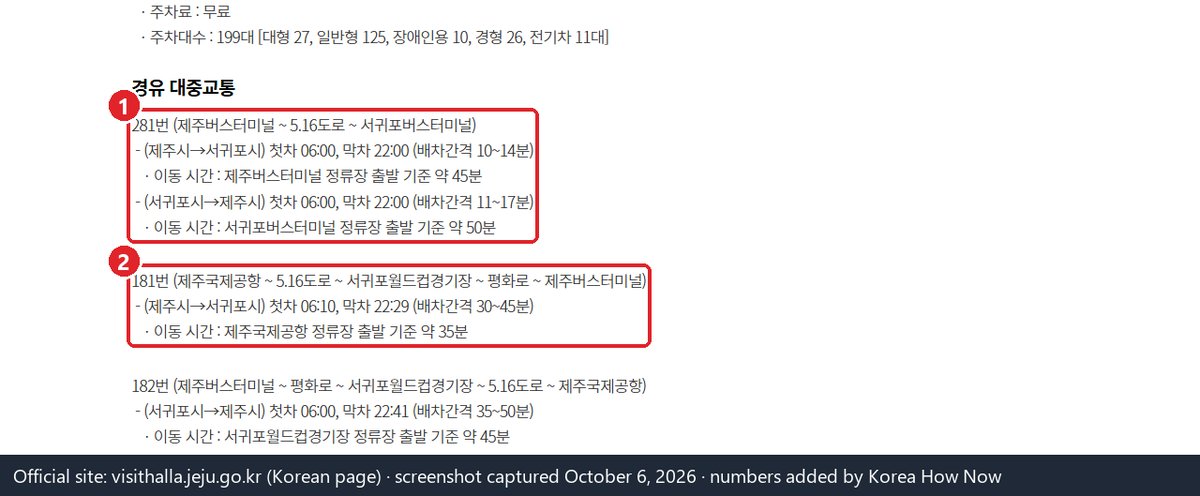
All three routes run along the 5.16 road (Route 1131), which passes the Seongpanak trailhead. Times are from the Jeju bus timetables on bus.jeju.go.kr (281 in force from June 24, 2026; 181 and 182 from August 1, 2024), checked October 15, 2026. First / last means the first and last departure from the starting stop.
| Bus | From | Direction | First / last | Every | Time to Seongpanak |
|---|---|---|---|---|---|
| 181 (express) | Jeju International Airport | Airport → 5.16 road → Seogwipo | 06:40 / 22:15 | 40–60 min | ~46 min (the park says ~35) |
| 281 | Jeju Bus Terminal | Jeju City → 5.16 road → Seogwipo Bus Terminal | 05:40 / 22:00 | 10–20 min | ~41 min from terminal |
| 281 | Seogwipo Bus Terminal | Seogwipo → 5.16 road → Jeju City | 05:55 / 22:00 | 10–20 min | ~47 min from Seogwipo |
| 182 (express) | Seogwipo World Cup Stadium | Seogwipo → 5.16 road → Jeju Airport | 06:05 / 21:25 | 30–60 min | ~40 min from World Cup Stadium |
How the loops fit together:
- 181 runs airport → Jeju Bus Terminal → 5.16 road → Seogwipo, then back via the Pyeonghwa road, so you can also catch it at Jeju Bus Terminal. Use it to get to Seongpanak from the airport.
- 182 runs the other way: Jeju Bus Terminal → Pyeonghwa road → Seogwipo → 5.16 road → Jeju Airport. Use it to get back from Seongpanak to the airport.
- 281 is the frequent workhorse between Jeju Bus Terminal and Seogwipo Bus Terminal. Use it if you’re staying in Jeju City or Seogwipo.
Airport to Jeju Bus Terminal: buses 181 and 182 both link the airport with Jeju Bus Terminal, according to bus.jeju.go.kr. But if you’re starting at the airport, just stay on the 181 to Seongpanak rather than changing to the 281.
First bus vs your reservation slot
Since Dec 1, 2025, Hallasan summit bookings have two entry slots:
| Entry slot | Seongpanak places |
|---|---|
| 05:00–08:00 | 800 |
| 08:01–11:30 | 200 |
The first 181 leaves the airport at 06:40 and reaches Seongpanak at about 07:26. The first 281 leaves Jeju Bus Terminal at 05:40 and reaches Seongpanak at about 06:21. Both fit inside the 05:00–08:00 slot; if you want an earlier start from the airport, get to Jeju Bus Terminal for the 281. A 281 that leaves Jeju Bus Terminal by about 07:15 still gets you to Seongpanak before 08:00. The 07:20 181 from the airport arrives at about 08:06, outside the 05:00–08:00 slot, so with that bus you’d need an 08:01–11:30 booking.
The cut-off matters more than the slot. Winter hours run every year from October 1 to March 31:
| Seongpanak (winter hours) | Time |
|---|---|
| Trail opens | 05:00 |
| Last entry at the Seongpanak entrance and the Jindallaebat control point | 11:30 |
| Leave the summit by | 13:30 |
| Leave Jindallaebat shelter by | 15:30 |
In summer hours (April–September) the cut-off is 12:30 and the summit descent time 14:30. The park’s reservation guide page, the Seongpanak trail page and the park’s standing entry-time notice all give these same times.
The trail is 9.6 km one way and the park estimates 4 hours 30 minutes up. Arrive by about 07:30 and you have time; arrive at 10:00 and you probably won’t reach Jindallaebat by 11:30.
Bus fares
From the Jeju bus information system:
| Bus type | Adult card | Adult cash |
|---|---|---|
| Regular trunk bus (281) | 1,150 won | 1,200 won |
| Express bus (181, 182) | 2,000 won on boarding (covers 20 km) + distance fare when you get off | 3,000 won (maximum fare) |
On express buses the distance part is charged when you tap off: +200 won per extra 5 km, up to a cap of 3,000 won (over 40 km). So by card, airport → Seongpanak costs between 2,000 and 3,000 won. Tap your card again when you get off so the distance fare is worked out. The bus system doesn’t publish a stop-to-stop fare, so we can’t give the exact figure.
Youth (13–18) and child fares are lower; see the fare table on bus.jeju.go.kr.
Taxi
The Jeju bus information system publishes the island’s taxi rates (in force since July 1, 2024):
| Mid-size taxi | |
|---|---|
| Base fare (first 2 km) | 4,300 won |
| Distance fare | 100 won per 126 m |
| Long-distance surcharge (over 20 km) | 120 won per 126 m |
| Time fare (below 15 km/h) | 100 won per 31 seconds |
| Late night (23:00–04:00) | +20% |
| Calling a taxi | +1,000 won per call |
We haven’t found an official road distance from the airport to Seongpanak, so there’s no total here. Ask the driver for an estimate or check one in a taxi app before you ride. A taxi is the only way to start at 05:00 without a car, and it costs far more than the bus. The late-night surcharge stops at 04:00, so a 4:30 a.m. pickup doesn’t pay it.
Driving and parking
From the Hallasan trail and fee pages:
| Seongpanak lot | Park-and-ride | |
|---|---|---|
| Location | At the trailhead (516-ro 1865, Jocheon-eup) | 5.16 road near Jeju International University (Yeongpyeong-dong) |
| Spaces | 156 (131 regular, 8 compact, 7 EV, 5 accessible, 5 large) | 199 |
| Fee (small car) | 1,000 won first hour, then 500 won per 20 minutes, max 13,000 won per day (9+ hours) | Free |
| Fee (mid/large vehicle) | 2,000 won first hour, then 800 won per 20 min, max 20,000 won | Free |
A summit hike takes most of the day, so expect the daily maximum at Seongpanak. The main lot fills very early, which is why the park lists the park-and-ride. From there, take a Seogwipo-bound bus along the 5.16 road up to Seongpanak (281 runs most often); check which routes stop nearest the lot on bus.jeju.go.kr. Don’t park on the road shoulder instead: the park says it is enforced as illegal parking for about 4.5 km toward Jeju City and 2.3 km toward Seogwipo from the trailhead.
Renting a car at the airport? Creatrip lists a Jeju airport car rental with insurance included, free to change or cancel up to 3 days before: Jeju car rental on Creatrip (affiliate link). Check the rental’s licence rules first; most visitors need an International Driving Permit.
Getting back
- To Jeju Airport: bus 182 (on the 5.16 road heading toward Jeju City).
- To Jeju City / Jeju Bus Terminal: bus 281 toward Jeju City.
- To Seogwipo: bus 281 or 181 toward Seogwipo.
- Coming down via Gwaneumsa instead? Buses from that trailhead are in Seongpanak vs Gwaneumsa: which trail to take.
Last buses run until about 22:00 or later, so you won’t get stranded after a normal hike. With the winter summit descent time of 13:30, most hikers are back at the trailhead mid-afternoon.
Bus and taxi problems on the way to Seongpanak
The first bus is too late for the 05:00 opening.
It is. The earliest bus (281 from Jeju Bus Terminal at 05:40) gets you there at about 06:21. That’s still inside the 05:00–08:00 slot. If you want to be on the trail at 05:00, take a taxi or drive.
I took 181 and was charged 3,000 won.
On express buses you need to tap your card again when you get off. Paying cash always costs the maximum (3,000 won). By card, the bus system doesn’t say what happens if you forget to tap off, so don’t skip it.
I’m at the bus stop but the bus didn’t stop.
Check the direction. 181 heads toward Seogwipo on the 5.16 road; 182 comes the other way toward Jeju City and the airport. For the ride back, wait on the opposite side of the road from where you got off.
The Seongpanak lot is full.
Use the free park-and-ride on the 5.16 road near Jeju International University (199 spaces) and take a bus up.
I booked the 08:01–11:30 slot. Is a 10:00 bus OK?
You can enter, but from October to March you must pass Jindallaebat by 11:30, and it’s a long climb to get there. A 10:00 arrival almost certainly ends at the control point. Take the earliest bus you can.
Where do I buy food?
Sort out water and food in Jeju City or at the airport before the bus. Our Hallasan booking guide covers what you can and can’t carry on the trail. Reaching the summit? Take a photo at the top and apply for the summit certificate the same day; the park says it must be requested and issued on the day of your hike: how to get the Hallasan summit certificate.
Help
- Seongpanak branch office: +82-64-725-9950
- Jeju bus timetables and live bus locations: bus.jeju.go.kr (English available)
- Korea travel hotline (English): 1330
Prefer a taxi app? Our taxi app guide compares Kakao T, k.ride and Uber for visitors.
Read next
Sources
- Seongpanak trail page (buses 281/181/182, first and last buses, intervals, travel times, parking spaces, park-and-ride and its buses, entry and cut-off times, 9.6 km / 4.5 hours)
- Reservation guide (seasonal entry and descent times)
- Fees (Seongpanak parking)
- Seongpanak parking notice: park-and-ride, shoulder parking enforcement (Korean)
- Entry times by season, in force since July 1, 2024 (Korean)
- Time slots and quotas from Dec 1, 2025
- Winter hours Oct 1, 2026 – Mar 31, 2027 (park office announcement, reported Sept 28, 2026, Korean)
- Hallasan National Park directions (address, bus 281)
- Seongpanak visitor center (address, phone)
- Jeju bus routes, timetables and fares (281 = regular trunk bus; 181/182 = express; express fare rules)
- Jeju taxi fares (from July 1, 2024)