Last checked: October 20, 2026 · Sources: Korea Customs Service notices, the Narcotics Control Act and its rules (law.go.kr), and the Ministry of Food and Drug Safety (MFDS) permit guide, linked below.
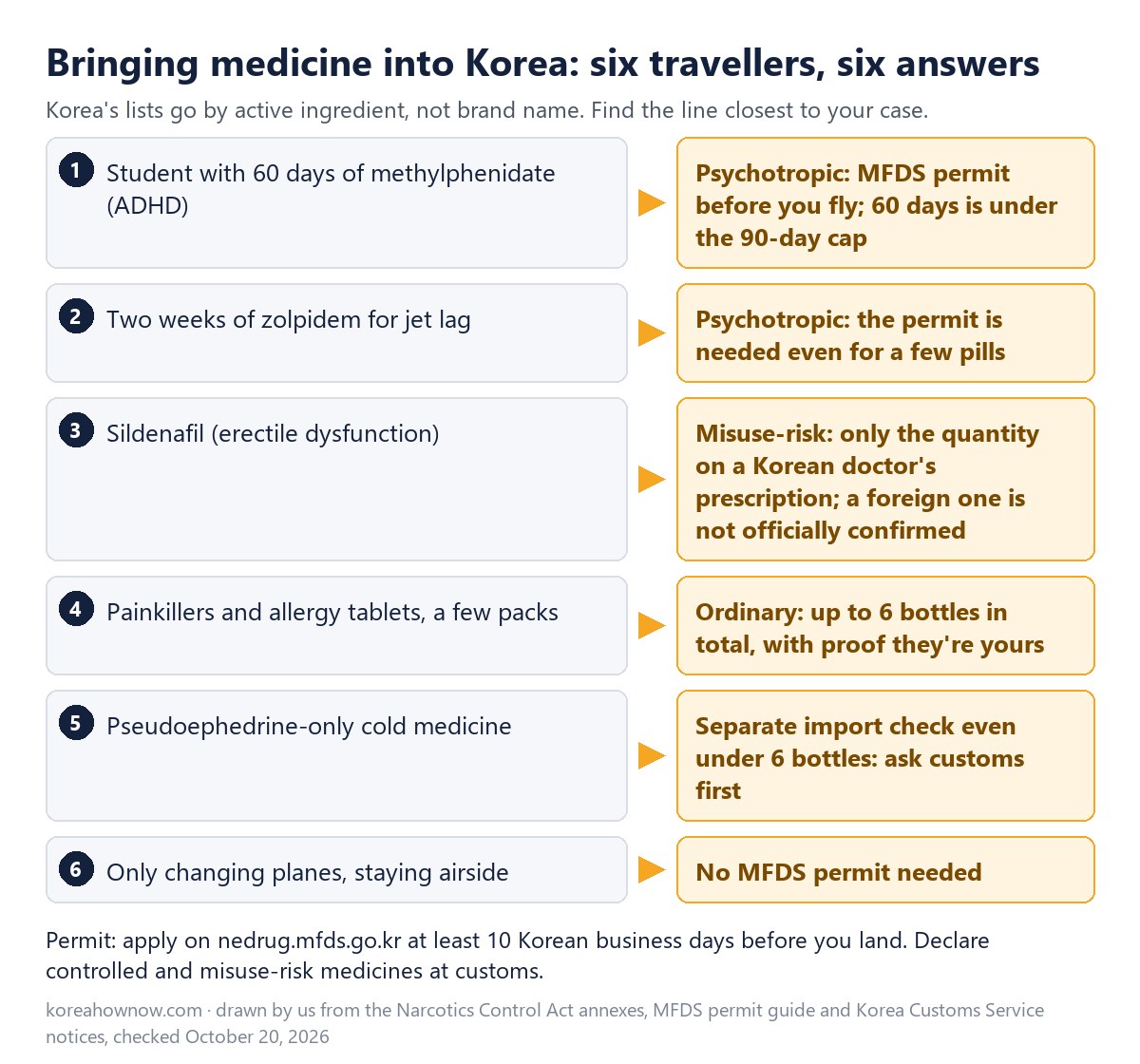
Yes, you can bring your own medicine into Korea, but which rule applies depends on what’s in it. Ordinary medicines for personal use clear customs up to six bottles in total, or up to three months’ supply by the dosing directions if you carry more. Medicines with a narcotic or psychotropic ingredient need a permit from the MFDS before you fly, applied for at least 10 business days before you land.
A third group, “misuse-risk” medicines such as erectile-dysfunction pills, clears customs only in the quantity on a prescription from a doctor in Korea. Check your medicine’s active ingredient, not its brand name, because Korea’s lists go by ingredient.
Which rule applies to my medicine?
| Your medicine | Customs limit | What you need |
|---|---|---|
| Ordinary medicine (not on the lists below) | 6 bottles in total; above that, up to 3 months’ supply by the dosing directions | Proof it’s for you: prescription, doctor’s note or pharmacy label |
| Misuse-risk medicine (오·남용우려의약품) | Only the quantity on a prescription from a doctor in Korea (국내 의사) | Prescription; a foreign one is not officially confirmed |
| Narcotic or psychotropic medicine (마약류) | Up to 90 days’ supply, only for your stay | MFDS permit before you fly |
| Cannabis-based medicine | Same permit route, under its own rule | MFDS approval before you fly |
| Supplements (health functional foods) | 6 bottles in total | — |
The bottle limits come from a Korea Customs Service table of self-use allowances. Medicines and supplements also count inside your general USD 800 duty-free allowance. Our customs allowance guide covers that limit and what to declare.
The table doesn’t define how blister packs or boxes count as “bottles”. If you’re carrying a lot, ask the Korea Customs Service through its English Q&A board before you fly.
Is my medicine controlled in Korea?
Korea lists controlled substances by active ingredient in annexes to the Enforcement Decree of the Narcotics Control Act. The lists are in Korean. When we searched them on October 20, 2026, these common medicines were on them:
- ADHD medicines: methylphenidate, amphetamine and lisdexamfetamine (psychotropic lists).
- Anxiety and sleep medicines: alprazolam, diazepam, clonazepam, lorazepam and zolpidem (psychotropic list).
- Codeine (narcotics list). Some low-dose mixtures are exempt, so ask the MFDS about a specific product.
If your medicine isn’t named above, that doesn’t settle it. We can’t rule on other medicines, and a name missing from a text search isn’t proof. Before you fly, email the MFDS narcotics team (narcotics@korea.kr, the address given in Korean embassy notices) with the active ingredient, or call the MFDS English line, +82-43-719-1564.
The MFDS also tells travellers to ask their own country’s embassy in Korea about controlled medicines.
Which medicines need a Korean prescription?
The MFDS names these as misuse-risk medicines:
- Erectile-dysfunction medicines: sildenafil, tadalafil, vardenafil, udenafil, mirodenafil, avanafil, alprostadil and others named in the notice.
- Furosemide.
- Listed anabolic steroids and testosterone forms, as tablets or injections.
- Dapoxetine, and clomipramine when it’s for premature ejaculation.
The customs table says these clear only in the quantity set on a prescription from a doctor in Korea. Whether a prescription from home counts is not officially confirmed, so check before you go.
A few ordinary medicines also need a separate import check even under six bottles. These include single-ingredient medicines containing pseudoephedrine, ephedrine, norephedrine, ergotamine or ergometrine, and anything with an endangered-species ingredient such as musk. Ask customs first if your medicine is one of these.
How do I get the MFDS permit?
You apply online on Drug Safety Korea, the MFDS e-service, which has an English entry page. The permit is only for the person who will take the medicine, not for a family member’s or friend’s medicine.
- Open nedrug.mfds.go.kr/eng/index and choose “Permit To Bring In Narcotics For Self-treatment”.
- Verify your email address and set a password, then log in.
- Click “New Application”. Enter your passport, flight and stay dates, then pick your medicine from the list, or choose “Other” and search the active ingredient.
- Enter the dose and how often you take it. The form works out the daily dose.
- Upload the documents in the table below, then click “Submit Application”.
- Check “Application List” for the result or for a request for more documents. The permit is also sent by email or fax.
| Document | What it must show |
|---|---|
| Passport | A full-page copy, clear enough to read the photo and details |
| Flight reservation | Entry and exit dates, flight numbers, airport, your name |
| Doctor’s letter or medical certificate | Hospital, your name, doctor’s name and signature, diagnosis, brand and generic name, how to take it, dose, quantity, date |
| Valid prescription | Your name and date of birth, date, generic name, dose, quantity |
| Export certificate (if your country issues one) | Government proof that you’re taking the medicine out. With it, the doctor’s letter and prescription can be skipped. If your country has none, tick “Not available” |
| Proof of a long stay (study or work) | For example, an exchange-student or posting letter |
Documents must be in English or Korean. Anything else needs a notarized translation, uploaded with the original.
How early do I need to apply?
Processing takes up to 10 business days, and the MFDS won’t accept an application filed less than 10 business days before you arrive. There’s no paid fast track. We found no fee for this permit in the Enforcement Rule’s fee list.
Count Korean business days back from your arrival date, skipping weekends and Korean public holidays. Our advice: apply three weeks ahead, not two. The MFDS can refuse an application with missing or incomplete documents, so leave time to fix them.
Worked example: landing over the year-end holidays
Say you land on Monday, January 4, 2027. Counting back 10 Korean business days from that date, skipping weekends, Christmas (Friday, December 25) and New Year’s Day (Friday, January 1), lands on Thursday, December 17, 2026. The MFDS doesn’t spell out whether the day you file or the day you land is counted, so treat Wednesday, December 16 as your real last day. Our three-weeks rule puts it at Monday, December 14, which leaves two business days to send a missing document. Around Seollal or Chuseok, Korea’s multi-day holidays push the deadline back the same way.
How much can I bring?
The permit covers what you’ll take during your stay, at most 90 days’ supply at the highest dose your doctor prescribed. You may add up to 5 days’ extra for flight delays. If you fly on to another country, attach those tickets and the permit can cover that leg too.
Staying longer than 90 days? The MFDS says to get the rest prescribed in Korea.
What happens at the airport?
Carry all your medicines in hand luggage, in their original packaging. The permit is sent to the agencies involved, so you don’t have to show it, but keep a copy.
Korean customs rules list narcotics, psychotropic medicines and misuse-risk medicines among the goods you must declare. Fill in the customs declaration and use the “Goods to Declare” lane. Customs can hold medicines that lack a required permit or approval.
Only changing planes? If you stay airside and don’t pass immigration, you don’t need the MFDS permit.
Can I have medicine posted to me in Korea?
Not controlled medicines. The MFDS prohibits mailing them into Korea, and customs destroys or returns any it seizes. For ordinary medicines sent by post, the MFDS says to ask customs.
Running short during your trip? Our Korean pharmacy guide explains what a pharmacy can sell you without a prescription and what needs a Korean doctor’s.
Read next
Part of our Arriving in Korea guide.
Sources
- Korea Law Information Center — Narcotics Control Act (마약류 관리에 관한 법률), Art. 2, 4, 57-2, in force Oct 2, 2026, checked Oct 20, 2026 (Korean)
- Korea Law Information Center — Enforcement Decree of the Narcotics Control Act, Art. 3 and annexes 1–8, in force Oct 2, 2026, checked Oct 20, 2026 (Korean)
- Korea Law Information Center — Enforcement Rule of the Narcotics Control Act, Art. 4, 5, 51, checked Oct 20, 2026 (Korean)
- Korea Law Information Center — KCS notice on travellers’ baggage clearance (여행자 및 승무원 휴대품 통관에 관한 고시, 2026-16), Art. 6, 16, 18, checked Oct 20, 2026 (Korean)
- Korea Law Information Center — KCS notice on import clearance (수입통관 사무처리에 관한 고시, 2025-66), annex 11 self-use allowances, checked Oct 20, 2026 (Korean)
- Korea Law Information Center — MFDS notice on misuse-risk medicines (오·남용우려의약품 지정에 관한 규정, 2025-81), checked Oct 20, 2026 (Korean)
- MFDS — Self Treatment Narcotics Bring in Permit, with guideline and FAQ, checked Oct 20, 2026
- MFDS — Manual on Permit to Bring in Narcotics to Korea (online application user manual), checked Oct 20, 2026
- MFDS — Drug Safety Korea (English), checked Oct 20, 2026
- Ministry of Foreign Affairs — Embassy of Korea in Lithuania, Bringing Medicines into Korea By Travel, Jun 20, 2025
- Korea Customs Service — Customs Clearance Guide for Passengers, checked Oct 20, 2026
- Korea Customs Service — English Q&A, checked Oct 20, 2026