
Last checked: October 23, 2026 · Sources: Korea Customs Service, Incheon Airport, the Customs Act and its Enforcement Rule, and the livestock and plant quarantine laws (law.go.kr), linked below.
Korea’s customs duty-free allowance is USD 800 per traveller for goods bought or received abroad. On top of that, you can bring alcohol up to 2 litres and USD 400 in total, 200 cigarettes (or one other tobacco type) and 100 ml of perfume. Anything over the limits, plus meat, fruit, plants and cash over USD 10,000, must be declared.
Only adults get the alcohol and tobacco part. If you have nothing to declare, you don’t fill in a form at all. You walk through the “Nothing to Declare” lane, though customs can still check your bags.
How much can I bring into Korea duty-free?
| Item | Duty-free limit per person | Notes |
|---|---|---|
| General goods | USD 800 in total value | Includes gifts and things bought at duty-free shops, in Korea too (how Korean duty-free shops work) |
| Alcohol | 2 L in total and USD 400 in total | On top of the USD 800. None if you’re under 19 |
| Tobacco | One type only: 200 cigarettes, or 50 cigars, or 200 heated-tobacco sticks, or 20 ml nicotine liquid, or 110 g other e-cigarette products, or 250 g other tobacco | On top of the USD 800. None if you’re under 19 |
| Perfume | 100 ml | On top of the USD 800 |
| Farm, fishery and herbal products | Within the USD 800: 40 kg in total, KRW 100,000 in total, usually 5 kg per item | Must pass quarantine first |
The tobacco limit is one kind, not one of each. If you bring cigarettes and cigars, only one type gets the allowance. Korea Customs says nicotine liquid must be under 1% nicotine for the allowance. Stronger liquid may need Ministry of Environment papers.
Alcohol, tobacco and perfume sit outside the USD 800. The rule says their limits apply “regardless of” the basic allowance, so a USD 300 bottle of whisky doesn’t use up any of your USD 800.
There’s no bottle count for alcohol any more, only the 2 L and USD 400 totals. Some airport form text still says “2 bottles”. Stay within 2 L and USD 400 and you’re inside both versions.
Who counts as under 19? Korea uses the year of birth. You get the alcohol and tobacco allowance from 1 January of the year you turn 19.
Did the allowance change in 2026?
No. The limits above are the ones in force on October 23, 2026, under Article 48 of the Enforcement Rule of the Customs Act. The rule was amended in 2026 (in force April 1, 2026), but that change only added duty-free purchases that couldn’t leave Korea because of a cancelled flight or similar unavoidable reason, and left the limits alone. The recent changes to the limits were:
| In force from | What changed |
|---|---|
| September 6, 2022 | Basic allowance raised from USD 600 to USD 800; alcohol from 1 bottle / 1 L to 2 bottles / 2 L (USD 400 in total) |
| May 1, 2023 | Under-19 rule counted by year of birth (from 1 January of the year you turn 19) |
| January 1, 2024 | Perfume raised from 60 ml to 100 ml |
| March 21, 2025 | The 2-bottle limit on alcohol dropped; 2 L and USD 400 remain |
Pages that still say “1 bottle, 1 litre” or “2 bottles” are out of date.
Does the allowance cover things I’m only using on my trip?
Everyday personal items you normally wear or carry, and work tools a non-resident needs for their job, are treated as traveller’s belongings under the customs rule. You don’t list your clothes and phone.
An expensive item you’ll take home again, such as a new camera or professional gear, is different. Customs lists personal goods and tools that a temporary visitor will take out again among goods to declare. Declare them when you arrive.
Gifts count. Incheon Airport Customs says goods you were given abroad are part of the allowance like anything you bought. Goods that look commercial, such as many of the same item, get no allowance at all.
What happens if I go over USD 800?
For general goods, customs takes the USD 800 off and charges duty on the rest. For alcohol, tobacco, perfume and farm products, going over that item’s own limit means the whole item is taxed, not just the extra. Incheon Airport says the same: if an item’s capacity or weight is over its limit, tax applies to the entire amount.
The airport form gives this example. You carry 3 bottles of alcohol, 10 packs of cigarettes, 30 ml of perfume and a USD 1,000 watch. You write down the alcohol and the watch. The cigarettes and perfume are within their limits, so you leave them off.
| You… | What happens |
|---|---|
| Declare it yourself | 30% off the customs duty, up to 200,000 won off |
| Don’t declare and get caught | A 40% penalty on the tax you owe, or 60% if you’ve already been penalised for this twice in the 2 years before this trip |
| Declare falsely or hide restricted goods | Goods can be confiscated; fines or prison under the Customs Act |
Our take: for most traveller goods, customs charges one flat combined rate, and the 30% discount (up to 200,000 won) comes off that. The 40% penalty is on all the tax you owe, including VAT. If you’re anywhere near the limit, declare.
Worked example: one adult’s bag at Incheon
| In the bag | Counts toward USD 800? |
|---|---|
| Watch bought abroad, USD 600 | Yes |
| Handbag from a Korean duty-free shop on the way out, USD 300 | Yes, duty-free shopping counts |
| Sweater a friend gave you abroad, USD 100 | Yes, gifts count |
| 1 L of whisky, USD 300 | No, it’s inside the separate alcohol limit |
| 50 ml of perfume | No, inside the 100 ml perfume limit |
| Your own phone, laptop and clothes | No, they’re traveller’s belongings |
The items that count add up to USD 1,000, which is USD 200 over. Declare them: duty is charged on the USD 200 part, and declaring yourself takes 30% off it. Now swap the whisky for two 1 L bottles at USD 250 each. That is still 2 L, but USD 500 is over the USD 400 alcohol limit, so the whole USD 500 is taxed, not just the extra USD 100.
Don’t carry bags or parcels for other people. Incheon Airport warns it may be illegal, and you’re responsible for what’s inside. If you must, declare those items or tell a customs officer.
What do I have to declare?
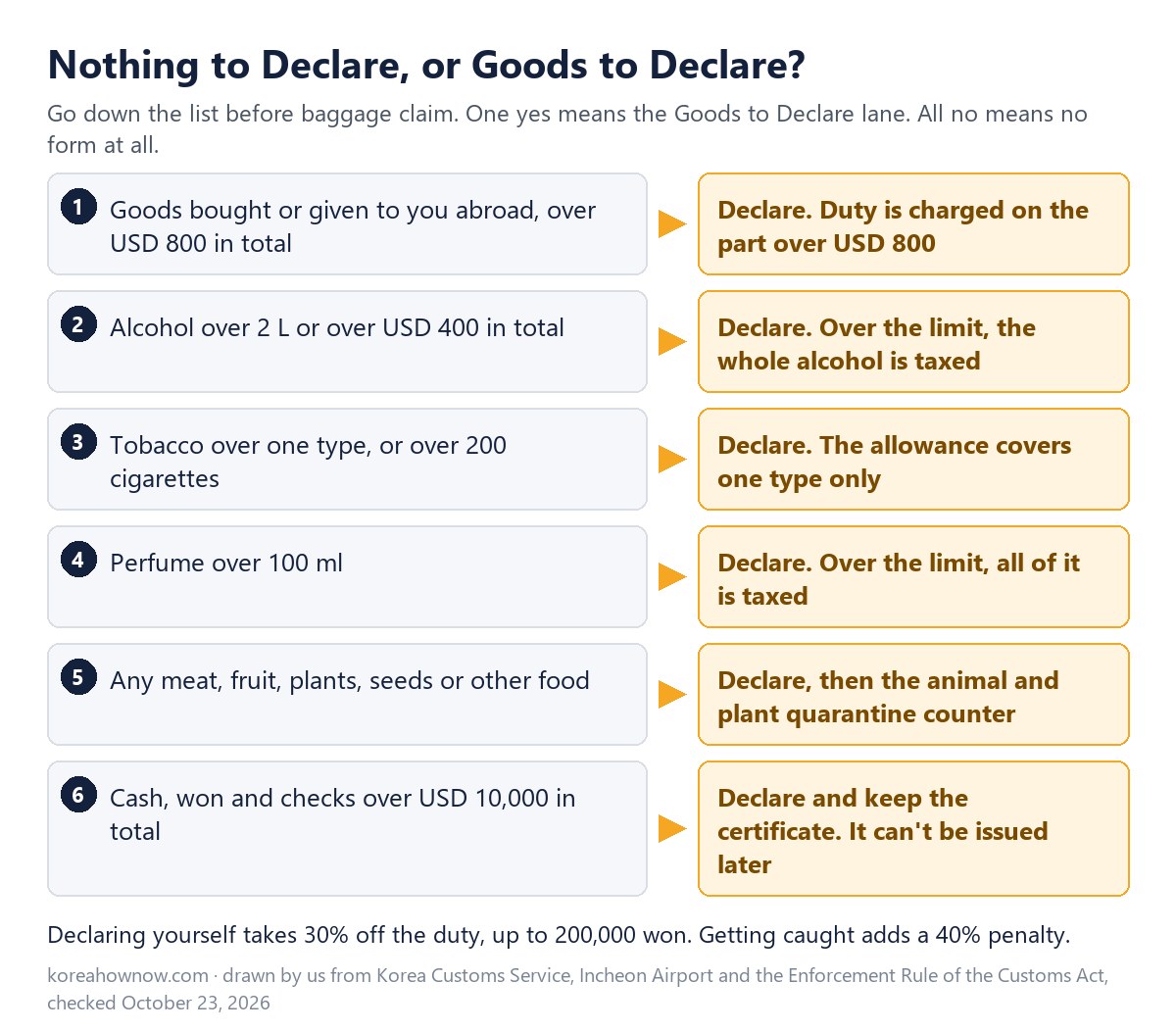
Use the “Goods to Declare” lane if you have any of these:
- Goods over the USD 800 allowance, or alcohol, tobacco or perfume over their own limits.
- Meat, ham, sausage, jerky, eggs, dairy, fresh fruit, vegetables, plants, seeds or other food.
- Cash and other means of payment over USD 10,000 in total. Our currency exchange guide explains how to declare it.
- Narcotic, psychotropic or misuse-risk medicines. See bringing medicine into Korea.
- Weapons and imitation weapons, including swords, gas sprays, Tasers and crossbows.
- Products of endangered species, such as ivory, some furs, coral and some traditional medicines.
- Commercial goods, samples or goods for repair.
Some goods can’t come in at all. Customs lists obscene material, forged money or securities, and material that harms national security.
Can I bring meat, fruit or plants into Korea?
Mostly no. Incheon Airport’s quarantine page lists all fresh fruit and fruit-bearing vegetables as prohibited imports. Meat and other livestock products can enter only from permitted countries, with a quarantine certificate from the exporting country, and only after inspection.
Declare all of them anyway, on the customs form, and go to the animal and plant quarantine counter in the customs area. Not declaring can cost from 100,000 won for fruit to 10 million won for pork. Item by item, with the full fine table and a worked example, see can you bring food into Korea.
Visited a farm abroad? Tick the box on the form. The quarantine office asks you to stay away from livestock for 5 days after you arrive.
How do I fill in the customs declaration?
- On the plane or in the arrival hall, take the paper Traveler Declaration Form. Or open the KCS “Traveler Customs Declaration” app or the mobile site m.customs.go.kr/tms (English, Chinese and Japanese available).
- Write only the items over the limits, plus anything on the list above. Items within their limits can be left off.
- Families travelling together need only one form.
- After baggage claim, take the “Goods to Declare” lane and hand the form to the officer, or show your mobile declaration.
- Pay the duty there, or in the app if you declared through it. Want to pay later? Ask the officer; the airport says deferred payment may be allowed.
People often ask about red and green channels. The official names are “Nothing to Declare” and “Goods to Declare”. Follow the words on the signs.
Who can I ask before I fly?
Use the Korea Customs Service English Q&A board linked below. At Incheon, customs is on 032-722-4422 (Terminal 1) and 032-723-5119 (Terminal 2). From abroad: +82-32-722-4422 (Terminal 1) or +82-32-723-5119 (Terminal 2).
Part of our Arriving in Korea guide.
Sources
- Korea Customs Service — Customs Clearance Guide for Passengers, checked Oct 23, 2026
- Korea Customs Service — Traveller baggage clearance (여행자 휴대품 통관), checked Oct 23, 2026 (Korean)
- Incheon Airport Customs — Arrival customs procedure and duty-free goods, checked Oct 23, 2026 (Korean)
- Korea Customs Service — Traveler Customs Declaration mobile site, checked Oct 23, 2026
- Korea Customs Service — Declaration of Foreign Currency, checked Oct 23, 2026
- Korea Customs Service — English Q&A, checked Oct 23, 2026
- Incheon Airport — Customs Declaration, checked Oct 23, 2026
- Incheon Airport — Animal and Plant Quarantine, checked Oct 23, 2026
- Korea Law Information Center — Enforcement Rule of the Customs Act (관세법 시행규칙), Art. 48 and amendment history (2022-09-06, 2023-05-01, 2024-01-01, 2025-03-21, 2026-04-01), current version in force Jul 31, 2026 (Korean)
- Korea Law Information Center — Customs Act (관세법), Art. 96 and 241, in force Oct 2, 2026 (Korean)
- Korea Law Information Center — Enforcement Decree of the Act on the Prevention of Contagious Animal Diseases, annex 3 fines (Korean)
- Korea Law Information Center — Enforcement Decree of the Plant Protection Act, fines annex (Korean)
- Korea.kr — No customs form needed if nothing to declare, from May 1, 2023 (Korean)