
Last checked: October 21, 2026 · Sources: Korea Customs Service, Foreign Exchange Transactions Regulations (law.go.kr), VisitKorea and Incheon Airport, linked below.
For currency exchange in Korea, go to a bank, a bank exchange counter at the airport, or a money changer registered with the Korea Customs Service. Bring your passport, because counters check ID. Ask for the exchange receipt and keep it: it’s what lets you change leftover won back into foreign currency before you fly home.
Each bank and changer sets its own rates. Registered money changers have to post that day’s buying and selling rates, so read the board before you hand over cash.
Where should you exchange money?
| Your situation | Where to go | Bring |
|---|---|---|
| Just landed at Incheon | Bank exchange counters on the arrival floor, some open 24 hours | Passport |
| In a city on a weekday, daytime | A bank branch (generally 09:00–16:00 on weekdays; hours vary by bank and region) | Passport |
| Evenings, weekends, shopping streets | A money changer that displays its customs registration certificate | Passport |
| You’d rather use a machine | An unmanned exchange machine from a registered operator, up to US$2,000 per day | Passport to scan |
| Flying home with leftover won | Bank counters on the departure floor at Incheon, before or after security | Passport and exchange receipts |
| Carrying more than US$10,000 in cash | Declare it to customs when you arrive | Traveler Declaration Form |
VisitKorea’s advice is short: change money at a bank or an authorized exchange service center. Korea Post Bank keeps slightly longer hours, 09:00–16:30. The arrival-floor counters and their hours are in our Incheon Airport arrival guide, so they aren’t repeated here.
Prefer a card to cash? See which Korean ATMs take foreign cards. Keep those ATM slips too; they matter when you change money back (see below).
Do you need a passport to exchange money in Korea?
Yes, as a rule. Under the Foreign Exchange Transactions Regulations, a money changer that buys your foreign cash must take an exchange application and check your ID, such as a passport. The only exception in the rules is an automatic coin exchange machine.
Unmanned exchange machines check who you are by scanning an ID document such as a passport or alien registration card, so have yours in hand.
One more catch from VisitKorea: some places may not accept old banknotes. If your notes are from an older series, check before you queue.
Which receipt should you ask for?
A bank that buys foreign currency from a non-resident must give you a document proving it: a purchase certificate, receipt or statement. It’s issued once.
A money changer must give non-residents a Certificate of Foreign Exchange Purchase (외국환매입증명서), also issued once. The rules don’t oblige anyone to reissue it, so treat it like a ticket.
There is a gap to know about. The same rules let a money changer buy or sell up to US$2,000 per person per day without the application and certificate forms (US$4,000 at counter changers that file their exchange ledger electronically with customs). A small exchange may come with no certificate unless you ask for one. Ask anyway.
Who counts as a non-resident? Under the Enforcement Decree, a foreigner becomes a resident by working in Korea or staying six months or more. A tourist on a short trip is on the non-resident side, which is what the rest of this page assumes.
How do registered money changers work?
Money changers (환전영업자) are private businesses that register with the Korea Customs Service. They can register to work at a counter, through unmanned machines, or online. Customs posts a nationwide list of registered changers every month on its Korean website, as a spreadsheet.
A registered changer has to:
- Display a sign in Korean and a foreign language saying it exchanges money, plus its registration certificate, where customers can easily see them
- Post that business day’s buying and selling rates, or give you another way to check them
- Trade only from its registered premises
Customs also tells changers to make exchange easy for foreign tourists. If you can’t see a certificate or a rate board, walk on to the next one.
Can you use an unmanned exchange machine?
Yes, if it belongs to an operator registered with customs for unmanned machines. Each person can exchange up to US$2,000 a day at such an operator. The higher US$4,000 limit in the rules is tied to filing the exchange ledger electronically with customs; whether a given machine applies it is not officially confirmed — check before you go.
The operator has to run a customer support centre that takes calls during the machine’s published hours and can deal with breakdowns. Before you feed in notes, note the support number shown on or near the machine and take a photo of it.
WOWPASS kiosks also accept foreign cash; how they work is in our T-money vs WOWPASS vs Climate Card comparison.
How do you change won back before you leave?
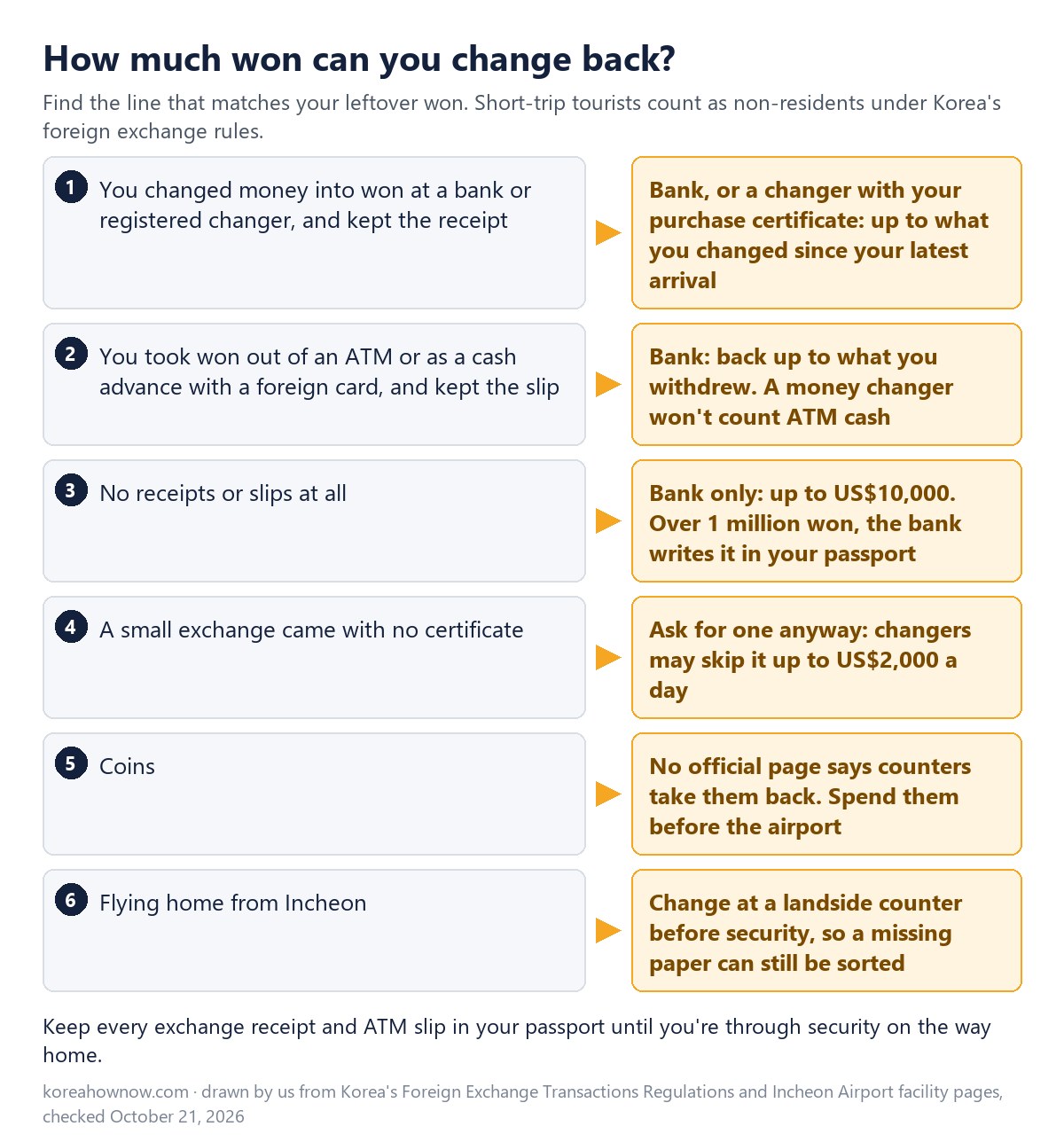
Banks and money changers follow different rules here, and the bank rules are more generous.
At a bank, a non-resident can buy foreign currency with won:
- Up to the amount you exchanged into won since your latest arrival in Korea, at a bank or a registered money changer
- Up to the won you took out in Korea with a foreign credit or debit card, by ATM withdrawal or cash advance
- If you have neither record, up to US$10,000. The bank then writes the amount in your passport, unless it’s 1 million won or less
For the first two, the bank asks for papers that prove the earlier exchange or withdrawal, and notes the date and amount.
At a money changer, changing back is allowed only within the amount you exchanged into won since your latest arrival. You hand over a re-exchange application, your Certificate of Foreign Exchange Purchase and your passport. (Casino winnings at that changer’s own casino are the other exception.)
Our take: keep every exchange receipt and ATM slip tucked in your passport until you’ve cleared security on the way home. With them, you can change back what you exchanged or withdrew. Without them, you’re relying on the bank’s US$10,000 no-record allowance or on a changer agreeing to a small no-paperwork exchange.
Worked example: four travellers with leftover won
| Leftover won and papers | Where to change it | What happens |
|---|---|---|
| Changed US$300 at a registered changer, kept the certificate, 120,000 won left | A bank, or the changer with its certificate | All 120,000 won, since it is less than what was changed into won |
| Took 500,000 won from an ATM with a foreign card, kept the slip, 200,000 won left | A bank, with the slip | All 200,000 won. A money changer can only go by what you exchanged with it, not ATM cash |
| Lost every paper, 1,500,000 won left | A bank | All of it under the US$10,000 no-record allowance. It’s over 1 million won, so the bank writes the amount in the passport |
| 4,300 won in coins | None we could confirm | Spend them before the airport |
No official page we opened says whether counters take back won coins. Spend coins before you reach the airport.
Where can you change money on the Incheon departure floor?
Incheon Airport lists these exchange counters on the departure floor (3F). “Airside” means after security and passport control, in the duty-free area.
| Terminal | Counter | Where | Hours |
|---|---|---|---|
| T1 | Woori Bank | Near Departure Hall 4 | 24 hours |
| T1 | KB Bank | Near Check-in Counter F | 24 hours |
| T1 | Hana Bank | Near Departure Hall 2 | 06:00–22:00 |
| T1 | Hana Bank | Near Exit 11 | 06:00–22:00 |
| T1 | KB Bank | Near Check-in Counter L | 06:00–22:00 |
| T1 airside | Woori Bank | Near Gate 11 | 24 hours |
| T1 airside | KB Bank | Near Gate 25 | 06:00–22:00 |
| T1 airside | Hana Bank | Near Gate 29 | 06:00–22:00 |
| T2 | KB Bank | Near Exit 4 | 24 hours |
| T2 | KB Bank | Near Departure Hall 1 | 06:00–22:00 |
| T2 | KB Bank | Near Check-in Counter L | 06:00–22:00 |
| T2 | Hana Bank | Across from Check-in Counter L | 06:00–22:00 |
| T2 | Woori Bank | Near Exit 9 | 06:00–22:00 |
| T2 airside | Woori Bank | Near Gate 249 | 24 hours |
| T2 airside | KB Bank | Near Gate 251 | 06:00–22:00 |
| T2 airside | Hana Bank | Near Gate 275 | 06:00–22:00 |
Each terminal also has full bank branches in the basement or on 2F, open 09:00–16:00; the airport lists the T2 Woori branch as closed on weekends and holidays, so plan on weekdays. Counter hours change from time to time, so check the airport’s facility page on the day.
We’d change money back at a landside counter before security. If the counter needs your receipts and something is missing, you still have time to sort it out, which you won’t at the gate.
Do you have to declare cash in Korea?
Only above US$10,000. Customs adds up foreign currency, Korean won notes and checks, including cashier’s checks. If the total is more than US$10,000 when you arrive, you must declare it.
To declare on arrival:
- Mark “yes” for item 3 on the Traveler Declaration Form and write the amount.
- Hand the form to a customs officer.
- Get the Certificate of Foreign Currency Declaration and keep it.
Customs can’t issue that certificate after you’ve entered Korea, so do it at the airport, not later.
When you leave, carrying US$10,000 or less needs no report. A non-resident also needs no new report to take out foreign currency within what they brought in on the latest arrival, but customs requires the declaration certificate for that. Cash withdrawn with an overseas card is covered too, if you carry a confirmation certificate from the foreign exchange bank.
Leaving with more than US$10,000 that you didn’t declare on arrival (and didn’t withdraw with an overseas card)? The regulations say you must report it to customs on an export declaration form, with papers showing where the money came from, so go to the customs desk before check-in. Customs lists baggage inspection numbers at 032-722-4422 (T1) and 032-723-5119 (T2).
Skipping a required declaration carries a penalty of up to one year in prison or a fine of up to 100 million won. If three times the amount involved is more than that, the fine can go up to three times the amount.
Sources
- Korea Customs Service — Declaration of Foreign Currency (English) — checked Oct 21, 2026
- Korea Customs Service — Money changers board, monthly list of registered money changers (Korean) — checked Oct 21, 2026
- law.go.kr — Foreign Exchange Transactions Regulations, Arts. 2-2, 2-3, 2-28, 2-29, 6-2, in force Sept 16, 2026 (Korean) — checked Oct 21, 2026
- law.go.kr — Korea Customs Service Notice on the Management of Money Changers, Art. 8, in force June 8, 2026 (Korean) — checked Oct 21, 2026
- law.go.kr — Foreign Exchange Transactions Act Enforcement Decree, Art. 10 (resident vs non-resident), in force Apr 28, 2026 (Korean) — checked Oct 21, 2026
- VisitKorea (Korea Tourism Organization) — Korean Currency & Exchange Info, Mar 27, 2023 — checked Oct 21, 2026
- Incheon Airport — Convenience Facilities, Terminal 1 — checked Oct 21, 2026
- Incheon Airport — Convenience Facilities, Terminal 2 — checked Oct 21, 2026