
Last checked: October 28, 2026 · Sources: Seoul Metropolitan Government transport pages (night buses, fares, taxi fares, Climate Card), Seoul Metro and TOPIS, linked below.
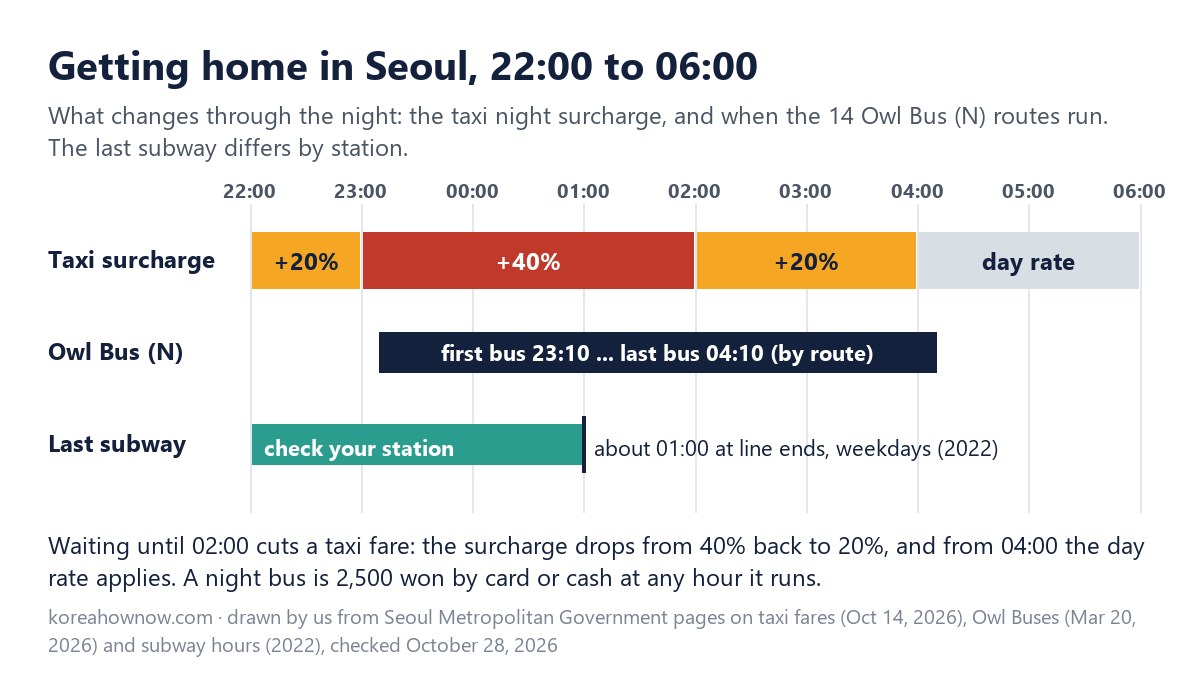
When the subway stops, Seoul’s night buses take over. They’re city buses with an “N” in front of the route number, and the city calls them Owl Buses (올빼미버스, olppaemi beoseu). Fourteen routes cross the city, with the first buses leaving around 23:10 and the last around 04:10. The adult fare is 2,500 won, whether you tap a transport card or pay cash.
They run every 10 to 40 minutes depending on the route, so they’re slower than a taxi but much cheaper. Seoul taxis add a night surcharge of up to 40% from 22:00 to 04:00.
Which night bus routes run in Seoul?
Seoul lists 14 Owl Bus routes, last updated in March 2026. The times below are each route’s first and last bus. Seoul gives 23:00 to 06:00 as the overall service window.
| Route | Between | Every | First – last bus |
|---|---|---|---|
| N13 | Sanggye-dong – Jangji-dong | 20–30 min | 23:30 – 03:40 |
| N15 | Ui-dong – Sadang Station | 15–30 min | 23:30 – 03:30 |
| N16 | Dobongsan – Onsu-dong | 20–30 min | 23:50 – 03:45 |
| N26 | Banghwa-dong – Sinnae-dong | 20–25 min | 00:00 – 03:25 |
| N30 | Gangil-dong – Seoul Station | 30–35 min | 23:10 – 03:50 |
| N31 | Gangil-dong – Jeongneung-dong | 35–40 min | 23:30 – 03:50 |
| N37 | Jangji-dong – Jingwan-dong | 25–30 min | 00:00 – 03:10 |
| N51 | Siheung-dong – Hagye-dong | 30 min | 23:40 – 03:45 |
| N61 | Sinjeong-dong – Sanggye-dong | 10–30 min | 23:40 – 04:10 |
| N62 | Sinjeong-dong – Myeonmok-dong | 15–20 min | 23:40 – 03:10 |
| N64 | Gaehwa-dong – Yeomgok-dong | 30–35 min | 23:40 – 03:15 |
| N72 | Susaek-dong – Sinnae-dong | 30–40 min | 23:30 – 03:45 |
| N73 | Gusan-dong – Jangji-dong | 35 min | 23:30 – 03:35 |
| N75 | Jingwan-dong – Sillim-dong | 25–30 min | 23:30 – 03:50 |
The two digits tell you roughly where a route goes. When Seoul launched the Owl Bus, it said the first digit is the starting zone and the second the end zone. N16, for example, runs from zone 1 (Dobong-gu, in the north) to zone 6 (Guro-gu, in the southwest). Zone 0 is the city centre.
Landing at Incheon late? The airport has its own night buses with different fares, listed in our Incheon Airport arrival guide.
How much does a night bus cost?
| Rider | Transport card | Cash |
|---|---|---|
| Adult | 2,500 won | 2,500 won |
| Youth (13–18) | 1,600 won | 1,800 won |
| Child (6–12) | 1,400 won | 1,400 won |
That’s Seoul’s bus fare table, in force since August 12, 2023. A daytime trunk or branch bus costs 1,500 won by card, so the night fare is 1,000 won more. There’s no early-morning discount on night buses.
Do transfers work on night buses?
Yes, with a T-money-type card such as T-money or WOWPASS. Night buses are Seoul city buses, so they’re part of the integrated transfer system. Cash rides get no transfer discount. With a Climate Card, every ride inside its coverage is already included, so there’s nothing extra to pay.
- After 21:00 and until 07:00, you have 60 minutes (not the daytime 30) from getting off to the next boarding.
- You pay the higher base fare of the vehicles you use. Night bus to subway, or subway to night bus, means 2,500 won as the base.
- The first 10 km are covered by the base fare. After that, adults pay 100 won more for every 5 km.
- Tap your card when you get off, too. Seoul Metro says that if the card doesn’t touch the reader when you get off, you lose the free transfer.
Can I use the Climate Card on a night bus?
Yes. Seoul says the Climate Card short-term pass covers Seoul-licensed city and village buses, “including night buses”.
The pass runs until the last service on its final day, which Seoul says is usually 04:00 the next morning. So a pass that ends on Friday still works on a night bus at 02:00 Saturday. Whether a pass is worth it for you is in our T-money vs WOWPASS vs Climate Card comparison.
How do I find and catch a night bus?
- Plan the route in a map app before you set off. Our Naver Map in English guide covers transit directions. Search with the time you’ll actually leave, so the app knows the subway has stopped.
- Check the arrival time. Seoul’s arrival screens at bus stops show night buses, and so does the city’s TOPIS traffic site.
- Look for the “N” number. Seoul puts an owl character next to the route number on the bus’s front and side LED signs, so you can spot it at night.
- Tap your card when you board and again when you get off.
With buses 20 to 40 minutes apart on many routes, check the arrival time first. Missing one can mean a long wait at 2 a.m.
When does the last subway leave?
It depends on your line and station, so check that station’s timetable, or the Seoul Metro site or a map app, before you go out.
Seoul’s 2022 announcement extended weekday service to about 01:00 at the end of the line, but not on Saturdays, Sundays or holidays. The last train from a station in the middle of a line leaves earlier than that. And when you change lines, the connecting train may already have gone.
What does each option cost after midnight?
We worked these out from Seoul’s official taxi fare rules. They’re for a standard (중형, junghyeong) meter taxi, counting distance only. In slow traffic (under 15.72 km/h), the meter also adds time charges, so real fares can be higher. Rounded to 100 won.
| Distance | Night bus (card, one ride) | Taxi 22:00–23:00 or 02:00–04:00 | Taxi 23:00–02:00 | Taxi daytime, for comparison |
|---|---|---|---|---|
| 5 km | 2,500 won | about 8,800 won | about 10,200 won | about 7,300 won |
| 10 km | 2,500 won | about 13,500 won | about 15,700 won | about 11,200 won |
| 20 km | 2,500 won, plus 100 won per 5 km over 10 km if you transfer | about 22,600 won | about 26,300 won | about 18,800 won |
How we got the taxi numbers: Seoul’s night base fare is 5,800 won (22:00–23:00 and 02:00–04:00) or 6,700 won (23:00–02:00) for the first 1.6 km. After that it’s 120 or 140 won for every 131 m, against 4,800 won and 100 won in the day. For 10 km at 23:30, that’s 6,700 + 64 × 140 = about 15,700 won.
A few more rules from Seoul’s fare page:
- Leaving Seoul by taxi adds a 20% outside-city surcharge. Together with the night surcharge it can reach 60%.
- Deluxe (black) and large taxis start at 8,400 won for 3 km at night, with a flat 20% night surcharge.
- Premium and van services such as Kakao Venti and Uber Black have their own fare rules, and Seoul’s page shows they can apply surge pricing of up to 4 times. How to call a taxi as a visitor is in our taxi app guide.
Night bus or taxi: which should I take?
| It’s… | Best bet |
|---|---|
| Before the last train from your station | The subway. Check your station’s last train, not the end-of-line time |
| 22:00–23:00, subway still running but you’re tired | Subway or taxi. The taxi surcharge is 20% at this hour |
| 23:00–02:00, subway stopped | Night bus if an N route passes near you. This is when taxis cost 40% more |
| 02:00–03:30 | Night bus if one’s due soon; taxi surcharge drops back to 20% |
| After about 04:00 | Taxi at the normal day rate, or wait for regular buses and trains. Seoul’s last Owl Bus leaves at 04:10 (N61) |
Our take: if you’re alone and an N route passes near your door, take the bus. For 10 km between 23:00 and 02:00 it saves you about 13,000 won.
In a group the gap shrinks fast. Four adults pay 10,000 won by bus against about 15,700 won for one 10 km taxi, so splitting the taxi costs each person only about 1,400 won more, with no wait in the cold.
If an N bus doesn’t pass near where you’re going, don’t try to piece one together with a long walk at 3 a.m. Take a taxi, and if you can wait somewhere warm, leave after 02:00, when the surcharge drops from 40% to 20%.
Part of our getting around Korea guide.
Sources
- Seoul Metropolitan Government — Late-night city buses (Owl Bus): 14 routes, hours and fare, updated Mar 20, 2026 (Korean) — checked Oct 28, 2026
- Seoul Metropolitan Government — Transport fares: bus fare table (Aug 12, 2023) and integrated transfer discount, updated Jul 11, 2025 (Korean) — checked Oct 28, 2026
- Seoul Metropolitan Government — Seoul taxi fares, updated Oct 14, 2026 (Korean) — checked Oct 28, 2026
- Seoul Metropolitan Government — Taxi night surcharge from 22:00, Dec 1, 2022 (Korean) — checked Oct 28, 2026
- Seoul Metropolitan Government — Climate Card (short-term pass), updated Oct 12, 2026 (Korean) — checked Oct 28, 2026
- Seoul Metropolitan Government — Owl Bus launch: route numbering and arrival information (Korean) — checked Oct 28, 2026
- Seoul Metropolitan Government (Seoul Mediahub) — Subway runs to 1 a.m. again, May 30, 2022 (Korean) — checked Oct 28, 2026
- Seoul Metro — User Guide: fares and night transfer time — checked Oct 28, 2026
- Seoul TOPIS — real-time traffic and bus information (Korean) — checked Oct 28, 2026