
Last checked: November 14, 2026 · Sources: the National Fire Agency, the Korean National Police Agency (as reported by Korea.net), the Korea Disease Control and Prevention Agency, the National Emergency Medical Center and Seoul city, linked below.
Call 119 for an ambulance, a serious injury or a fire, and 112 for the police. The fire agency says 119 rooms answer foreign callers through staff who speak the language or a three-way call with an interpreter. Seoul says the 119 ambulance is free.
If it isn’t an emergency, go to a clinic that is open rather than a big hospital ER, and call 119 for advice if you can’t tell how serious it is. 1339 is the disease agency’s line for infectious diseases; for an ambulance, call 119.
Which number do you call?
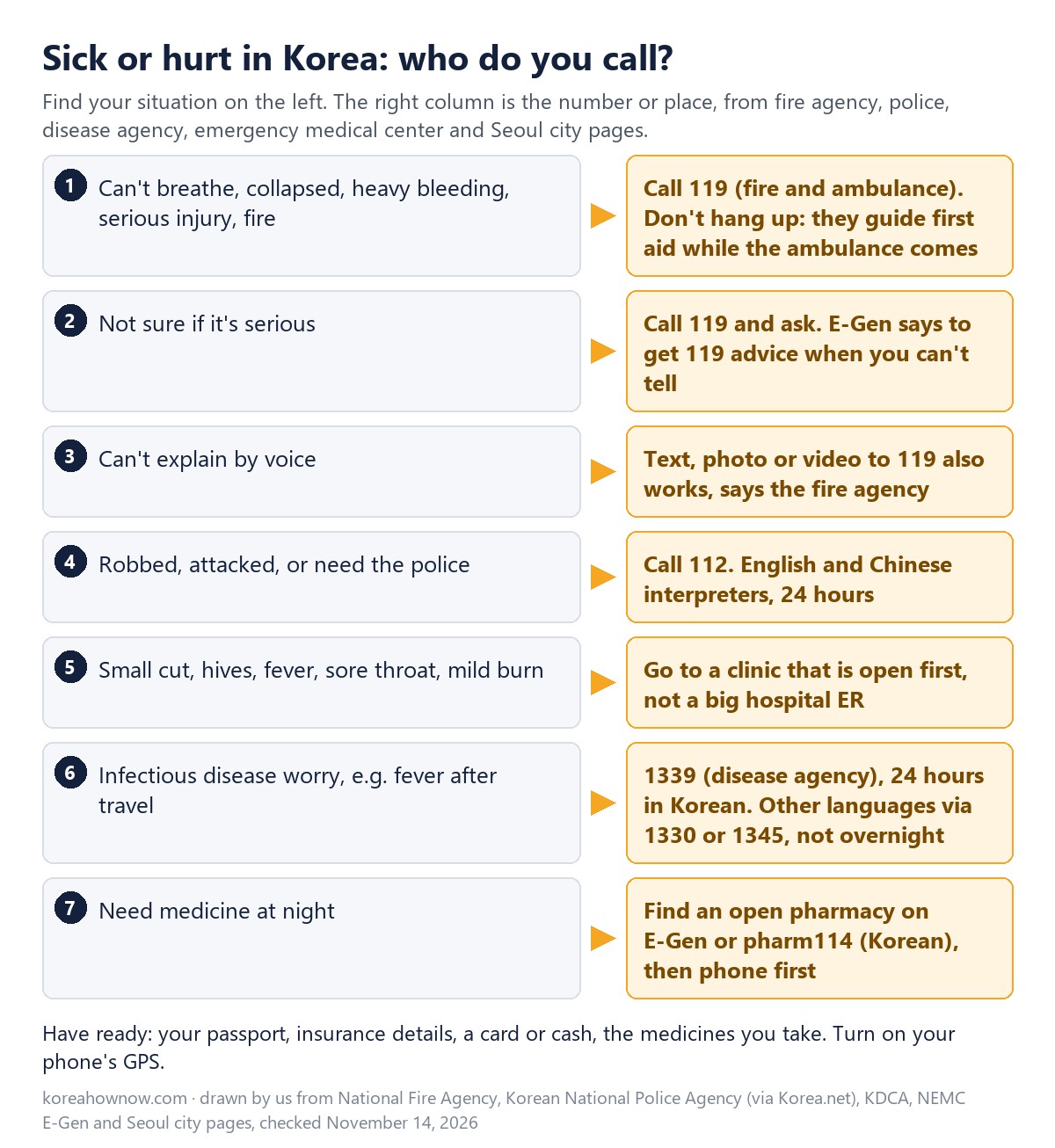
| Your situation | Number or place | Language help |
|---|---|---|
| Someone collapsed, can’t breathe, is badly hurt or bleeding; any fire | 119 | Staff who speak the language or a three-way interpreter call (fire agency) |
| You can’t tell if it’s an emergency | 119, for advice | Same as above |
| You can’t talk on the phone | Text, photo or video to 119 | Offered partly for foreigners who struggle with voice calls |
| Theft, assault or anything for the police | 112 | English and Chinese interpreters, 24 hours |
| Small cuts, hives, fever, sore throat, mild burns | A clinic (병원·의원) that is open | Depends on the clinic |
| A possible infectious disease, or questions about one | 1339 | Three-way call through 1330 (07:00–24:00) or 1345 (09:00–22:00) |
| Medicine at night or on a holiday | An open pharmacy (약국) | See our pharmacy guide below |
For travel questions and general interpretation, the 1330 line is covered in our 1330 Korea travel hotline guide.
Does 119 speak English?
Yes, through interpretation, but no national page gives a language list. In a 2019 press release, the National Fire Agency said 119 rooms across the country answer foreign callers in one of two ways. Either a dispatcher who speaks the language takes the call, or the room sets up a three-way call with a volunteer interpreter.
Seoul’s foreigner portal says interpreters are available for callers who don’t speak Korean, and it names English, Chinese, Japanese, Mongolian and Vietnamese. Visit Seoul’s medical page, last updated in 2018, says 16 languages. The two pages don’t agree on the exact list, so start the call in English or your own language anyway.
The fire agency also says it can locate 119 callers on a mobile phone. Since 2011, 119 has accepted reports by text, photo and video call, a service the agency says it first set up partly for foreigners who struggle with voice calls.
What do you say when you call 119?
The fire agency’s own call guide runs in this order:
- Say there is a patient: “Hwanja-ga isseumnida” (환자가 있습니다).
- Give the address. If you don’t know it, give the name and phone number of a large nearby building, the lift’s ID number, or the number on a utility pole. In the mountains, give the national grid point number (국가지점번호). Turn on your phone’s GPS.
- Say what’s wrong: where it hurts, and whether the person is conscious and breathing.
- Give their age and any known illness or regular medicine.
- Give your name and a second contact number.
- Don’t hang up. The dispatcher guides first aid while the ambulance is on its way.
If someone else is with you, the agency suggests they wait outside where the ambulance can see them. That gets the crew to the patient faster.
Is a 119 ambulance free?
Seoul’s foreigner portal says “The ambulance service is provided free of charge.” We didn’t find the same line on a National Fire Agency page, so outside Seoul we can’t confirm it from an official source. The ride and the hospital are separate. The fire agency’s list of things to bring includes money or a credit card.
What should you have ready before the ambulance comes?
The fire agency lists:
- ID or passport, and your insurance card or documents
- Money or a credit card, and shoes
- The medicines the patient takes every day
- Lock up, and switch off gas and electric appliances
When the crew arrives, tell them what happened, any change since you called, the first aid you gave, and the patient’s illnesses and medicines. Visit Seoul adds one step for visitors: if you have travel accident insurance, contact your insurer.
If you carry prescription medicine, our guide to bringing medicine into Korea covers what you can bring and the permits.
How do you find an ER that’s open?
The National Emergency Medical Center runs E-Gen, the official finder for ERs, hospitals and pharmacies. The search is in Korean. The English E-Gen site describes the center but has no search.
- Open the ER search (응급실 찾기) on e-gen.or.kr.
- Allow location, or type an address or place name in the location box.
- Pick a radius of 1, 3, 5 or 10 km and sort by distance (거리순) or by whether the ER is treating patients now (진료여부순).
- You can filter by level, from regional emergency centers (권역응급의료센터) down to local emergency rooms (지역응급의료기관).
E-Gen asks people with small cuts, hives, stomach ache or headache, fever, a sore throat or mild burns to try an open clinic first. A national campaign line on E-Gen puts it bluntly: big hospital ERs are for severe emergency patients.
For medicine late at night, our pharmacy guide explains the official finders for open pharmacies and what convenience stores can sell.
What is 1339 for, and why do some pages get it wrong?
1339 is the Korea Disease Control and Prevention Agency’s call center. It answers questions about infectious diseases, travel vaccinations and disease reporting, 24 hours a day, free from a Korean phone. Foreign callers are put through a three-way call with the 1330 travel line or the 1345 immigration contact center, so foreign-language help is not round the clock: KDCA lists 1330 at 7 a.m. to midnight and 1345 at 9 a.m. to 10 p.m.
Some official tourism pages still describe 1339 as a medical emergency line. VisitKorea’s FAQ says 1339 will “connect you with the nearest hospital,” and a Visit Seoul safety page calls it the “Emergency Medical Information Center.”
KDCA’s own pages list disease information, vaccination advice and disease reporting, and say nothing about ambulances or finding a hospital. VisitKorea’s emergency page also lists 1339 for infectious diseases only. Follow KDCA: for an ambulance, call 119.
Worked example: a fall at night in Busan
Say your friend slips on stairs at 11 p.m., can’t put weight on an ankle, and is fully awake and talking. Here is the order the official pages point to:
- It isn’t life-threatening, but you can’t judge a fracture. E-Gen says to call 119 for advice when you can’t tell how serious it is.
- On the call, follow the fire agency’s order: there’s a patient, the address, what happened, age and medicines, your name and a second number.
- If the dispatcher sends an ambulance, have the passport, insurance details and a card ready, as the fire agency suggests.
- If you go to hospital yourself, use E-Gen’s ER search, sorted by distance, and check that the ER is open.
Common mistakes and what to do instead
| Mistake | What to do instead |
|---|---|
| Calling 1339 for an ambulance | Call 119. 1339 is for infectious diseases |
| Hanging up once the call is taken | Stay on the line; the dispatcher guides first aid |
| Not knowing the address | Give a big building’s name, the lift ID or a utility pole number; turn on GPS |
| Going to a big hospital ER with a small cut or a mild fever | Try an open clinic first, as E-Gen asks |
| Relying on a data-only eSIM to dial 119 | No official source says it works; see our guide to calling Korean numbers on a data eSIM |
What about international clinics?
Visit Seoul lists the international healthcare offices of five large Seoul hospitals. They keep weekday office hours, and some open Saturday mornings, so they are no substitute for an ER at night. The list was last updated in 2018, so check each hospital’s own site. We don’t recommend particular hospitals.
What we’d do: save 119 and 112 in your phone before you land, and turn on location services. If you’re unsure, call 119 rather than 1330. Of these numbers, only 119 sends an ambulance, and the emergency center tells people to ask 119 when they can’t tell.
Part of our Korea travel guides.
Part of our Arriving in Korea checklist.
Read next
Sources
Sources (13)
- National Fire Agency, (보도자료) 외국인을 위한 119 이용방법 홍보 강화: how 119 handles foreign callers, July 23, 2019 (Korean), checked Nov 14, 2026
- National Fire Agency, 119 구급신고 요령: how to report to 119 (Korean), checked Nov 14, 2026
- National Fire Agency, 구급차가 오기 전 준비: what to prepare before the ambulance (Korean), checked Nov 14, 2026
- National Fire Agency via Korea Policy Briefing, 119 reports by text, photo and video call, February 4, 2024 (Korean), checked Nov 14, 2026
- National Fire Agency, Public EMS: U-Safety Call and caller location, checked Nov 14, 2026
- Seoul Metropolitan Government, Medical Facilities: emergency services 119 and 112, checked Nov 14, 2026
- Visit Seoul (Seoul Tourism Organization), Medical Emergencies (last updated August 2018) and Safety, checked Nov 14, 2026
- Korea.net (Ministry of Culture, Sports and Tourism), Interpretation service for 112 police hotline expanded to 24/7, March 19, 2024, checked Nov 14, 2026
- Korea Disease Control and Prevention Agency, 1339콜센터 (Korean) and Call Center (English), checked Nov 14, 2026
- VISITKOREA (Korea Tourism Organization), Emergency Situations and FAQ: Who can I call in an emergency situation while in Korea?, checked Nov 14, 2026
- National Emergency Medical Center E-Gen, 응급실 찾기: ER search (Korean), checked Nov 14, 2026
- National Emergency Medical Center E-Gen, 명절 연휴 응급의료 이용 안내: when to use a clinic instead of an ER (Korean), checked Nov 14, 2026
- National Emergency Medical Center, English site, checked Nov 14, 2026