
Last checked: October 20, 2026 · Sources: templestay.com, the official site of the Cultural Corps of Korean Buddhism, linked below.
You book a templestay in Korea on the official English site, templestay.com: pick a temple and a date, then book as a guest or with an account. A one-night stay at Jogyesa in central Seoul costs 80,000 won, and short day programs range from free to about 50,000 won.
Prices, payment and refund rules are set by each temple, so read the listing before you pay.
What kind of templestay should you pick?
The site sorts every program into three types. Choose by how much time you have and how much structure you want.
| Type | How long | What you do |
|---|---|---|
| One-day | Usually 2–3 hours | Temple tour, meditation, tea ceremony |
| Experience-oriented | Usually one night, often at weekends | Morning chanting, 108 prostrations, monastic meal, meditation, a craft such as a lotus lantern |
| Rest-oriented | One night or more | Meals and ceremonies, the rest is free time |
Overnight programs are usually one night, but some temples let you stay longer. The site’s FAQ says the maximum varies by temple and is usually about ten days.
How much does a templestay cost?
Each temple sets its own price. These are real listings on templestay.com when we checked; several of them are listed to run until December 31, 2026, so 2027 prices may differ:
| Temple (program) | Type | Adult price |
|---|---|---|
| Templestay Information Center, Seoul (Conversation with a monk over tea) | One-day | Free |
| Bongeunsa, Seoul (BONG-PASS, Tuesdays 10:00–16:00) | One-day | 5,000 won |
| Jogyesa, Seoul (Seon of Tea, tea ceremony) | One-day | 50,000 won |
| Jogyesa, Seoul (Regular program, 1 night) | Experience | 80,000 won per night |
| Beopjusa, Chungbuk (Weekdays rest) | Rest | 80,000 won per night |
| Haeinsa, Gyeongnam (Healing Haein, weekdays) | Rest | 70,000–100,000 won, by room type |
| Bulguksa, Gyeongju (Cultural experience with Buddhist dance, 2 days 1 night) | Experience | 130,000 won |
Children and teenagers pay less at some temples and the same at others. Jogyesa charges 80,000 won for every age, while Bulguksa charges 120,000 won for teenagers and 110,000 won for children.
A room to yourself costs extra where it’s offered. Beopjusa lists a single room at 110,000 won for its rest program and 130,000 won for its experience program.
What two adults or a family of four pay for one night
Our sums from the listed prices, before travel:
| Who and where | Sum | Total |
|---|---|---|
| Couple at Jogyesa, Seoul (sleep in separate rooms) | 2 × 80,000 | 160,000 won |
| Couple at Beopjusa, weekday rest, shared rooms | 2 × 80,000 | 160,000 won |
| Same, each in a single room | 2 × 110,000 | 220,000 won |
| Two adults, a teenager and a child at Bulguksa, 2 days 1 night | 2 × 130,000 + 120,000 + 110,000 | 490,000 won |
| The same family at Jogyesa (one price for every age) | 4 × 80,000 | 320,000 won |
Cancelling changes the sums a lot. Two days before, Bulguksa refunds 70%, so the family above gets 343,000 won back. Jogyesa refunds nothing from 6 days before, so its 320,000 won is gone. If your dates might move, the temple’s refund table matters as much as the price.
How do you book on templestay.com?
- Open the English site and go to Reservation, then Reservations.
- Filter by area (Seoul, Gyeongbuk and so on) and program type. Tick “Temples for Foreigners” to see programs aimed at foreign visitors.
- Open a program. Read the price list, schedule, refund policy and rules on that page.
- Pick an open date on the calendar and set the number of adults, teenagers and children. The total price appears.
- Press Reservation. On the sign-in page, choose “Apply as a non-member”, or sign in.
- Fill in name, age, gender, nationality, phone and email. Foreigners don’t need to pick a Korean region.
- Press Next and pay, or follow the temple’s payment rule shown on its listing.
You don’t need an account for regular programs, though some limited-time events require one. We followed the steps up to the guest booking form on October 20, 2026, without submitting it, and the guest option was there.
If you prefer an account, you can sign up with email or log in with Google or Facebook. Guests check their booking later from the “Guest” link at the top of the site.
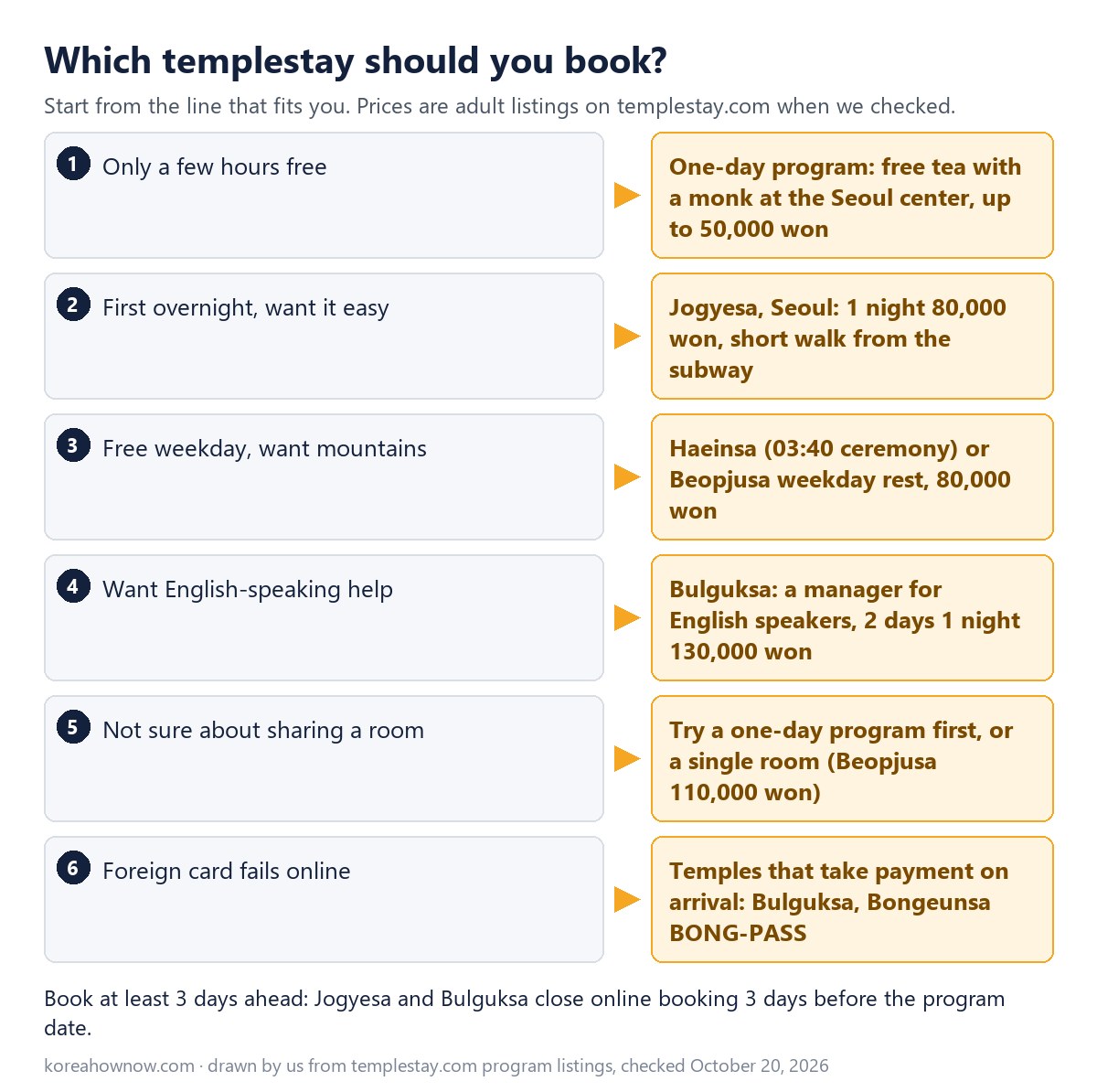
Book early. Jogyesa and Bulguksa close online booking 3 days before the program date. Many programs run only on set dates: Jogyesa’s one-night program showed just three open dates in November 2026.
How do you pay, and do you get a confirmation?
Payment depends on the temple:
- Jogyesa: pay online by card (it recommends doing it on a computer) or by bank deposit. Unpaid bookings are cancelled automatically, and you can’t pay by card at the temple.
- Bulguksa: if paying in advance from abroad is hard, you can pay by card or cash when you arrive.
- Bongeunsa BONG-PASS: pay by card or cash when you arrive.
Whether the online payment accepts every foreign card is not officially confirmed — check before you go. If your card fails, look for a temple that takes payment on arrival, or email the temple.
Some temples don’t send a confirmation letter. You don’t need to show one, because each temple keeps its own reservation list. To check a booking, email the temple or support@templestay.com with the booking name, date and temple.
What happens during an overnight stay?
Expect an early start. Here is part of Jogyesa’s one-night schedule from its listing:
| Time | Day 1 |
|---|---|
| 13:30 | Meet at the information office, left of the main gate; change into the temple uniform |
| 13:40–16:30 | Temple etiquette, paper lotus lantern, tea or sutra copying, temple tour |
| 16:30–17:45 | Evening monastic meal |
| 17:55–18:20 | Dharma instruments and evening ceremony (optional) |
| 19:00–19:50 | 108 prostrations (optional) |
| 21:00 | Lights out |
| Time | Day 2 |
|---|---|
| 04:00 | Wake up |
| 04:25–05:00 | Early morning ceremony with a monk (optional) |
| 07:00–07:30 | Morning monastic meal |
| 10:00 | Check-out |
Mountain temples start earlier still. At Haeinsa, guests leave for the main hall at 03:10 for a ceremony at 03:40. Beopjusa wakes guests at 04:00.
The formal monastic meal is called balwoo gongyang. You eat from a set of bowls, everyone gets the same food, and nothing is wasted. Check the schedule to see whether your program includes it.
If you feel unwell or tired, you can skip a session. Tell the templestay staff.
What should you wear and bring?
Most temples give you a uniform of a vest and trousers. Most also provide soap and toothpaste. Jogyesa adds a towel and a hair dryer, and Haeinsa a hair dryer.
Bring these yourself:
- Towel and toiletries
- Socks (Haeinsa requires socks in the halls, and Bongeunsa doesn’t allow bare feet)
- A T-shirt with sleeves to wear under the vest
- Sneakers or other closed shoes; flip-flops are not allowed at Haeinsa or Beopjusa
- Warm layers, since mountain temples get cold, especially in winter
What are the rules at a temple?
- No alcohol and no smoking.
- Dress modestly. Sleeveless tops and flip-flops are discouraged or banned, depending on the temple.
- Keep quiet. Haeinsa asks for “noble silence” during your stay; Bulguksa asks for quiet at meals.
- Greet monks with palms together and a small bow (hapjang).
- Men and women sleep in separate rooms. At Jogyesa, couples are split even if they’re family, except parents with minor children.
Rooms are usually shared. Some temples offer a private room for 2–4 people for an extra fee per person, and Jogyesa needs this requested and paid in advance, not on the day.
Which temples suit foreign visitors?
Use the “Temples for Foreigners” filter on the reservation page. The FAQ says Beopjusa, Bulguksa, Magoksa and Haeinsa, all UNESCO World Heritage temples, run English programs. Bulguksa’s listing names a manager for English-speaking guests, who can be reached by email or WhatsApp; it says the office is usually closed on Tuesdays and Wednesdays.
Seven temples in Seoul are an easy bus or subway ride: Bongeunsa, Geumsunsa, Hwagyesa, Jinkwansa, Jogyesa, Myogaksa and the International Seon Center.
Our pick: for a first stay, book a one-night program in Seoul at Jogyesa, because you can walk there from the subway and the 4 a.m. ceremony is optional.
If you have a free weekday and want a mountain setting, Haeinsa’s weekday program has the full 03:40 ceremony, and Bulguksa has a manager for English speakers. Try a one-day program first if you’re unsure about sharing a room.
Are there discounts for foreigners?
Sometimes, as limited-time events posted on the site’s Notice & Event board. In September 2026, the site ran a Special Templestay for Foreigners at 30,000 won per night. The November 2026 “Double Happiness” offer (30,000 won for one night) is for Korean nationals only, and its FAQ says foreigners can’t join.
Where is the Templestay Information Center in Seoul?
The center is on the first floor of the Templestay building, across the street from Jogyesa. You can pick up leaflets, ask which temple suits you, and join a free tea session with a monk (10:20–11:10; book it on the site like any program).
| Details | |
|---|---|
| Address | 1F, 56 Ujeongguk-ro, Jongno-gu, Seoul |
| Hours | 09:00–18:00, every day |
| Closed | New Year’s Day, Seollal and Chuseok holidays |
| Phone | 02-2031-2000 |
| Subway | Jonggak Station (Line 1) Exit 2 or Anguk Station (Line 3) Exit 6, about 5 minutes on foot |
The center was closed until the end of 2025 during fire restoration work at the Jogye Order’s International Conference Hall. A September 2026 notice only mentions a closure for Chuseok, so it appears to be open again — check before you go. The 5th floor has a temple food restaurant, Balwoo Gongyang.
How do you get to the temple?
Every listing has a “Way to Temple” tab with subway, bus or intercity directions. For Jogyesa, walk about 300 m from Jonggak Station Exit 2. For Haeinsa, the listing routes you by KTX to Dongdaegu, then subway to Daegu’s Seobu Intercity Bus Terminal, then a bus of about 1 hour 30 minutes, then a 30-minute walk or 5-minute taxi to the templestay quarters.
For Bulguksa, city buses 10, 11 and 711 run there from Gyeongju; see Seoul to Gyeongju by KTX or bus.
For the train leg, see how to book KTX with a foreign card. For a bus leg, see booking Korean express buses as a foreigner. Our getting around Korea page covers the rest. Staying at Jogyesa? Gyeongbokgung is close by, and hanbok wearers get in free.
What if you need to cancel?
Contact the temple directly or email support@templestay.com. To change your date, first check the program’s calendar for open dates. Refunds follow each temple’s own policy:
| Temple | Refund |
|---|---|
| Jogyesa | 7+ days before: 100%; 1–6 days before: none |
| Bulguksa | 3 days before: 100%; 2 days: 70%; 1 day: 50%; on the day: none |
| Haeinsa | 3 days before: 100%; 2 days: 80%; 1 day: 70%; on the day: none |
| Beopjusa | 3 days before: 100%; 2 days: 70%; 1 day: 10%; on the day: none (100% if weather or a natural disaster stops it) |
Programs can also be cancelled if too few people sign up, as the Jogyesa listings warn.
Sources
- Templestay (Cultural Corps of Korean Buddhism) — What is Templestay — checked Oct 20, 2026
- Templestay — FAQ — checked Oct 20, 2026
- Templestay — Reservations (program search) — checked Oct 20, 2026
- Templestay — Jogyesa Regular Templestay program (1 night 2 days) — checked Oct 20, 2026
- Templestay — Jogyesa Seon of Tea one-day program — checked Oct 20, 2026
- Templestay — Bulguksa Cultural Experience 2D1N — checked Oct 20, 2026
- Templestay — Haeinsa Healing Haein (weekdays) — checked Oct 20, 2026
- Templestay — Beopjusa Weekdays Rest — checked Oct 20, 2026
- Templestay — Bongeunsa BONG-PASS — checked Oct 20, 2026
- Templestay — Information Center: Conversation with a monk over tea — checked Oct 20, 2026
- Templestay — Sign In and non-member application — checked Oct 20, 2026
- Templestay — Templestay Information Center — checked Oct 20, 2026
- Templestay — How to get there — checked Oct 20, 2026
- Templestay — Information Center temporary closure notice (June 13, 2025) — checked Oct 20, 2026
- Templestay — Information Center Chuseok closure notice (Korean, Sept 18, 2026) — checked Oct 20, 2026
- Templestay — 2026 Special Templestay for Foreigners (Aug 11, 2026) — checked Oct 20, 2026
- Templestay — November 2026 Double Happiness Templestay (Korean, Sept 21, 2026) — checked Oct 20, 2026