
Last checked: October 30, 2026 · Sources: Animal and Plant Quarantine Agency, Incheon Airport, Korea Customs Service, Korea Post and the livestock and plant quarantine decrees on law.go.kr, linked below.
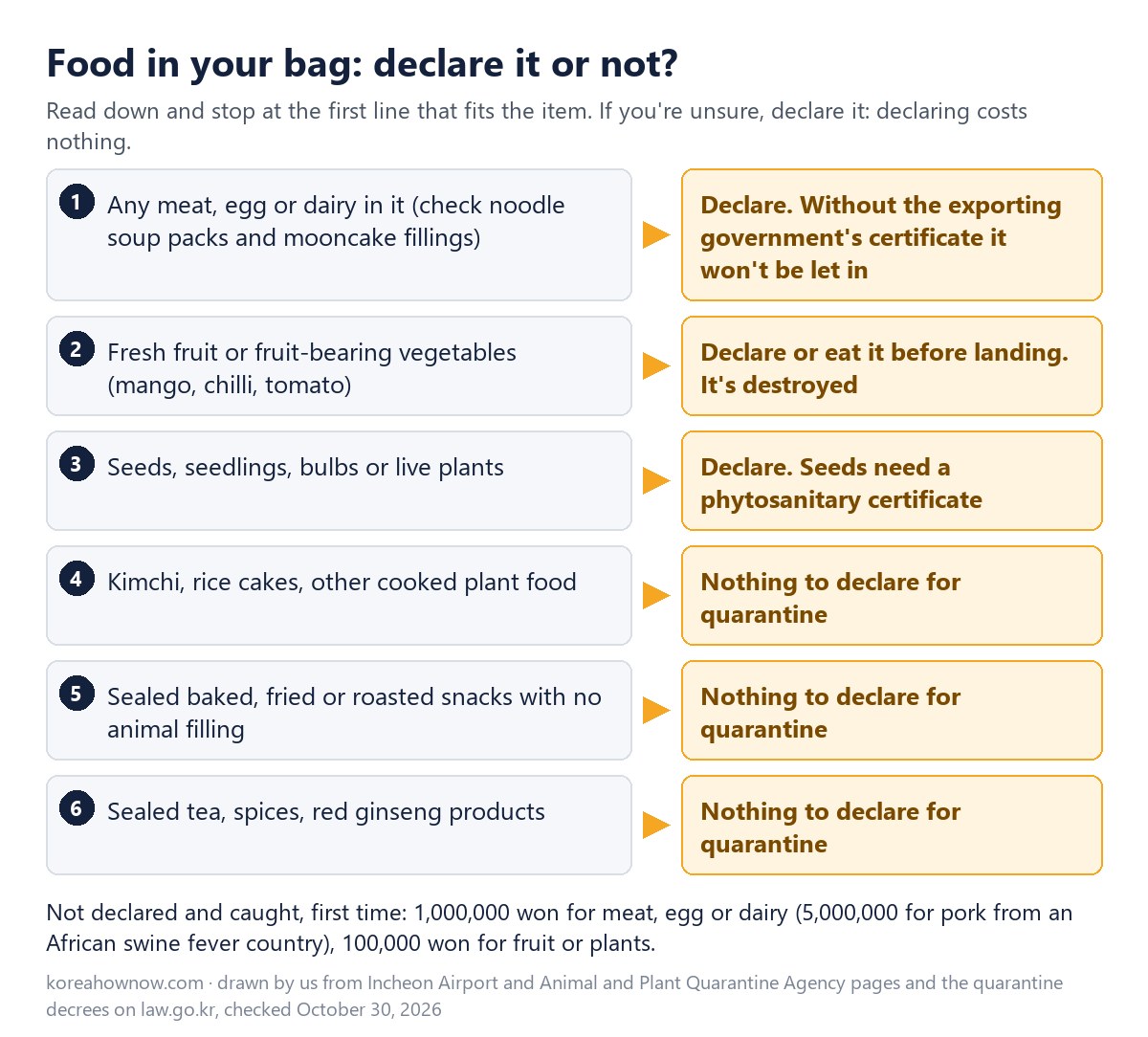
Some food, yes; most fresh and meaty food, no. Packaged snacks, cooked plant foods like kimchi and rice cakes, and sealed baked, fried or pickled goods are generally fine. Anything with meat, eggs or dairy, plus fresh fruit, vegetables and seeds, must be declared to quarantine when you land.
Meat products only get in with a government quarantine certificate from the country they come from, so shop-bought jerky or sausages without that certificate are refused. Fresh fruit is destroyed. Declaring costs you nothing. Not declaring, if you’re caught, means a fine: usually 100,000 won for fruit and 1 million won for meat the first time, and up to 10 million won for pork.
What can I bring into Korea, item by item?
This table is our summary of the official rules. “Declare” means tick the box on the customs form, or tell an officer, and show the item at quarantine.
| Your item | Allowed in? | What to do |
|---|---|---|
| Beef, pork, chicken, lamb (fresh, frozen, cooked) | Only with the exporting government’s quarantine certificate, from a country Korea accepts | Declare. Without a certificate, expect it to be refused |
| Jerky, ham, sausage, bacon, canned meat, canned stew | Same as meat. Incheon Airport lists them as processed meat | Declare |
| Instant noodles or curry with meat pieces or meat in the soup pack | Treated as a meat product. APQA has seized cup noodles with pork chashu sent by post | Read the ingredients. If there’s meat, declare |
| Plain instant noodles, no meat, egg or dairy | No animal quarantine. Packaged fried noodles are exempt from plant inspection | Nothing to declare for quarantine |
| Eggs, egg powder, salted egg yolk | Egg products need a certificate, like meat | Declare |
| Milk, cheese, butter, milk powder | Dairy products need a certificate, like meat | Declare |
| Fresh fruit (mango, orange, lychee, apple, cherry…) | No. Incheon Airport lists all fresh fruit and fruit-bearing vegetables as prohibited | Eat it before you land, or declare it and it’s destroyed |
| Fresh vegetables | Fruit-bearing ones (chilli, tomato, cucumber, aubergine…) are prohibited, and so are fresh potatoes, sweet potatoes and yams; other vegetables must be inspected | Declare |
| Seeds, seedlings, bulbs | Only with a phytosanitary certificate from the exporting country | Declare |
| Live plants, flowers | Inspected; some are banned outright | Declare |
| Kimchi, rice cakes, other cooked plant food | Yes. Not subject to plant inspection, Incheon Airport says | Nothing to declare for quarantine |
| Packaged baked, roasted or fried snacks (crackers, chips, cookies) | Yes, if they contain no meat, egg or dairy filling. Packaged roasted, baked, steamed, boiled or fried plant food is exempt | Check the ingredients |
| Sealed tea, spices, red ginseng products | Exempt from plant inspection when sealed in retail packs | Nothing to declare for quarantine |
| Pet food and pet treats with meat or other animal ingredients | Korea Post and APQA list them as restricted by mail. In luggage they’re animal products | Declare |
The customs form asks about food on its own lines. The Korea Customs Service lists meat, plants, fruit, vegetables, farm and livestock products “including processed goods” and “other foods” as goods to declare.
If you’re unsure, declare it. A declared item that can’t enter is taken away, and that’s the end of it. The fine is for not declaring, or declaring falsely.
How do I declare food at Incheon Airport?
- On the customs declaration form (paper, or the “Traveler Customs Declaration” app or website), tick the quarantine box for animal, livestock or plant products.
- After baggage claim, go to the “Goods to Declare” lane, not “Nothing to Declare”.
- Show the item to the quarantine officer. Animal products go to animal quarantine and plants to plant quarantine.
- The officer checks it. Items that pass go with you. Fresh fruit and other banned plants are destroyed on the spot, and refused animal products are returned or destroyed.
Seeds, sesame, chilli powder and similar items can be held back for a lab test, APQA warns.
Forms, the USD 800 allowance and the 40 kg farm-product limit are in our Korea customs duty-free allowance guide. For the full order of steps after landing, see our Incheon Airport arrival guide.
Questions before you fly? The quarantine office at Incheon Airport takes calls: livestock products T1 032-740-2671, T2 032-740-2007; plants T1 032-740-2079, T2 032-740-2002.
What is the fine for not declaring food in Korea?
These are the fines in the two quarantine decrees, for food you carried in and didn’t declare. They’re administrative fines, separate from customs duty.
| Not declared | 1st time | 2nd time | 3rd time or more |
|---|---|---|---|
| Pork, or a product containing pork, from a country Korea lists as having African swine fever, no certificate | 5,000,000 won | 7,500,000 won | 10,000,000 won |
| Any other meat, egg, dairy or animal product without a certificate (beef jerky, sausages, cheese…) | 1,000,000 won | 3,000,000 won | 5,000,000 won |
| An animal product that does have the certificate | 50,000 won | 100,000 won | 500,000 won |
| Fruit, vegetables, seeds or plants for your own use, not inspected or falsely declared | 100,000 won | 500,000 won | 1,000,000 won |
A second or third fine only counts as one if you were fined for the same thing in the 3 years before. Both decrees let officials cut the fine by up to half in some cases, for example an honest mistake rather than deliberate hiding. That’s their call, not something you can claim.
APQA uses detector dogs at Incheon and other airports, ports and the international post office.
Worked example: jerky, mooncakes and mangoes
Say you fly in with a 200 g bag of beef jerky, a sealed box of baked mooncakes with salted egg yolk, and 2 kg of fresh mangoes. It’s your first time.
- You declare all three. The mangoes are destroyed: fresh mango is a prohibited import. The jerky has no government certificate, so it’s refused. The mooncakes are baked and sealed, so plant quarantine doesn’t apply. The egg yolk makes them an egg product, though, so animal quarantine decides, and without a certificate expect them to go too. You pay nothing.
- You don’t declare and you’re caught. The jerky falls under “other animal product without a certificate”: 1,000,000 won (the egg-yolk mooncakes may be treated the same way). The mangoes add 100,000 won. That’s 1,100,000 won at least, and you still lose all three.
- Caught again within 3 years with the same bag: 3,000,000 + 500,000 = 3,500,000 won.
- If the jerky were pork from a country on Korea’s African swine fever list, the first fine alone would be 5,000,000 won.
The animal and plant fines come from different laws, so they’re added together. The plant decree also lets officials raise a fine by up to half when there’s more than one violation; the animal decree doesn’t say how several animal items in one bag are counted. We’ve used the minimum. Not officially confirmed — check before you go.
Our take: food rules don’t bend for gifts or sealed packaging. If something contains meat, egg or dairy and you don’t have the exporting government’s certificate, leave it at home or eat it on the plane.
Can I mail or ship food to Korea instead?
Mostly the same limits apply, and a parcel that fails is destroyed unless the person receiving it asks APQA to send it back. Korea Post’s quarantine notice lists what can and can’t come in by international mail:
| Can’t be mailed in | Can be mailed in (still inspected) |
|---|---|
| Meat of any kind, cooked or fried | Commercially made dairy products under 5 kg |
| Sausage, ham, jerky, snacks with meat, noodles with meat, curry or soup with beef | Sterilised canned, jarred or retort meat products under 5 kg, except anything with beef |
| Pet food and treats with animal ingredients | Fresh ginseng, dried mushrooms, spices, pine nuts, dried jujubes, peanuts, rice, beans |
| Eggs and egg products; dairy that is 5 kg or more, or not commercially made | Other dried produce |
| Most fresh fruit, potatoes, sweet potatoes, yams, walnuts in shell, dried persimmons | |
| Seeds and plants for planting, soil |
The person receiving the parcel is the one who must declare it to quarantine. Korea Post warns that hiding quarantine items in a parcel, or labelling them falsely, can bring up to 3 years in prison or a fine of up to 30 million won under the quarantine laws.
To ask about a parcel that failed quarantine, call APQA’s international mail team: animal products 032-740-2683 or 2684, plants 032-740-2088 to 2090.
Does this apply to supplements and medicine?
No, those follow different rules. Vitamins, health supplements and medicines have their own quantity limits and permits, covered in our guide to bringing medicine into Korea.
If you visited a farm abroad, tick that box on the customs form too. Incheon Airport asks you to keep away from livestock for 5 days after you arrive.
Read next
Part of our Arriving in Korea guide.
Sources
- Incheon Airport — Animal and Plant Quarantine (APQA Incheon Airport Regional Office) — checked Oct 30, 2026
- Incheon Airport — Customs Declaration — checked Oct 30, 2026
- Korea Customs Service — Customs Clearance Guide for Passengers: goods to be declared — checked Oct 30, 2026
- Korea Law Information Center — Enforcement Decree of the Act on the Prevention of Contagious Animal Diseases (가축전염병 예방법 시행령), Annex 3: fines, amended Apr 21, 2026 (Korean) — checked Oct 30, 2026
- Korea Law Information Center — Enforcement Decree of the Plant Protection Act (식물방역법 시행령), Annex 2: fines, amended Sep 2, 2025 (Korean) — checked Oct 30, 2026
- Animal and Plant Quarantine Agency — Prohibited plants (Korean) — checked Oct 30, 2026
- Animal and Plant Quarantine Agency — Processed products exempt from plant inspection (Notice 2019-52, Korean) — checked Oct 30, 2026
- Animal and Plant Quarantine Agency — Common misconceptions about plant quarantine (Korean) — checked Oct 30, 2026
- Animal and Plant Quarantine Agency — International mail quarantine for animal products (Korean) — checked Oct 30, 2026
- Animal and Plant Quarantine Agency, Incheon Airport Regional Office — Animal quarantine work (Korean) — checked Oct 30, 2026
- Animal and Plant Quarantine Agency, Incheon Airport Regional Office — Quarantine detector dogs (Korean) — checked Oct 30, 2026
- Korea Post (EMS) — Animal and plant quarantine for international mail (Korean) — checked Oct 30, 2026